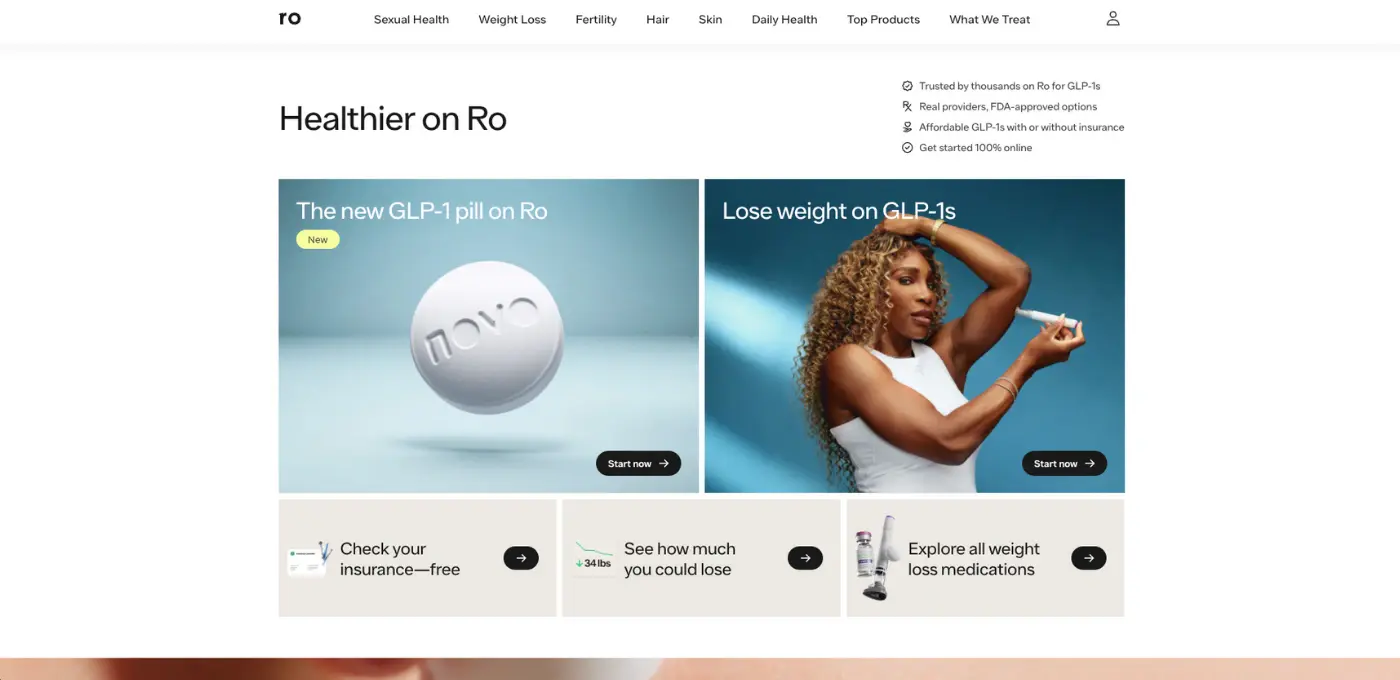
Ro and Sprout represent different approaches to weight loss telehealth - an established multi-category healthcare platform with a $1B+ valuation versus a value-tier single-category service. Ro offers weight loss alongside erectile dysfunction, hair loss, dermatology, women's health, and primary care at $145-375/month with 7+ years of track record and branded medication options, while Sprout provides straightforward compounded GLP-1 access from $149/month for semaglutide and $199/month for tirzepatide, verified September 17, 2026. Sprout's starting rates sit inside Ro's range rather than below it, so this comparison is about what multi-category coordination and branded medication flexibility are worth to you, not about which platform is cheaper.
Platform Overview
Ro launched in 2017 as a multi-category telehealth platform initially focused on men's health (erectile dysfunction) and later expanding into weight loss, hair loss, women's health, dermatology, and primary care services. With 7+ years of history, significant venture funding ($1B+ valuation), and positioning as premium full-service telehealth provider, Ro emphasizes high-quality care across multiple specialty categories with strong clinical protocols and established brand recognition.
The platform offers services across six main categories: weight loss (branded and compounded GLP-1s), erectile dysfunction (Viagra, Cialis, generics), hair loss (finasteride, minoxidil), women's health (birth control, emergency contraception), dermatology (acne, anti-aging), and primary care. Ro operates with licensed healthcare providers across all 50 states, offering both asynchronous consultations and video visits. For weight loss treatment, Ro charges $145-375/month depending on medication type.
Sprout is a weight loss telehealth platform built around compounded GLP-1 access without premium service layers. We can't verify its founding date, operating history or funding from our data, so we won't rank it on track record. What our listing does show is compounded semaglutide from $149/mo and compounded tirzepatide from $199/mo, verified September 17, 2026, with basic clinical support and no lifestyle programming or multi-category integration.
The platform offers asynchronous consultations with nurse practitioners or physicians, compounded GLP-1 medications (semaglutide and tirzepatide options), and basic ongoing support focused on medication management. Sprout starts semaglutide at $149/mo and tirzepatide at $199/mo, verified September 17, 2026, publishes no rate for higher doses, and serves multiple states with a straightforward transactional care model.
Service Scope and Multi-Category Access
Ro Multi-Category Healthcare Platform: Ro offers services across six health categories within single platform - weight loss, erectile dysfunction, hair loss, women's health, dermatology, and primary care. This multi-category scope enables coordinated care when patients need treatments across multiple categories, streamlined medication management, health optimization within unified provider relationship.
For weight loss specifically, Ro can coordinate GLP-1 treatment with erectile dysfunction medications (common comorbidity given metabolic syndrome connections), hair loss treatments affected by metabolic changes, dermatology services for skin concerns during weight loss, and women's health services for female patients.
According to research on metabolic syndrome, metabolic conditions often cluster together, making multi-category platforms valuable for managing interconnected health issues. Ro's broad scope enables care coordination impossible with single-category platforms.
Sprout Single-Category Focus: Sprout offers exclusively weight loss treatment with compounded GLP-1 medications, providing no additional health categories or services beyond basic GLP-1 access. The platform focuses on straightforward medication management - eligibility screening, prescription authorization, dosage escalation, and refill management - without lifestyle programming, multi-category coordination, or integration with broader health needs.
This narrow focus enables competitive value pricing while maintaining basic quality standards, but eliminates multi-category coordination benefits. Patients needing erectile dysfunction treatment, hair loss medications, dermatology services, or women's health care must coordinate these needs through entirely separate platforms. Those managing multiple metabolically-linked conditions cannot access integrated care coordination from single provider source. For patients needing only isolated weight loss treatment, this focused approach suffices. For those with multiple health needs, the single-category limitation creates care fragmentation.
Medication Options and Treatment Protocols
Ro Medication Access: Ro offers both branded FDA-approved GLP-1 medications (Wegovy, Zepbound when available) and compounded alternatives (semaglutide, tirzepatide), providing flexibility based on patient preferences, insurance coverage, and supply availability. The platform maintains relationships with both major pharmaceutical manufacturers and multiple compounding pharmacies, enabling medication continuity during shortages and offering choice between premium branded options and cost-effective compounded alternatives.
Ro's treatment protocols include structured dosage escalation, side effect management guidance, safety monitoring, and provider review of medication adjustments. The platform can transition patients between branded and compounded medications as supply situations change, maintain treatment continuity during drug shortages, and coordinate weight loss medications with other prescriptions patients receive through Ro's multi-category services. This medication flexibility and steady supply prove valuable for long-term treatment.
Sprout Compounded GLP-1s Only: Sprout offers compounded semaglutide and tirzepatide at value pricing, providing both primary GLP-1 options but no branded medication access. The platform focuses on compounded medications to optimize costs while offering choice between the two main GLP-1 types. This approach enables tirzepatide access for patients who benefit from newer formulation while maintaining value pricing.
However, the lack of branded medication options means patients cannot access FDA-approved Wegovy or Zepbound, transition to branded formulations if preferred for quality or insurance reasons, or benefit from pharmaceutical manufacturer quality control. For patients specifically seeking compounded GLP-1s at value pricing with choice between semaglutide and tirzepatide, Sprout provides reasonable options. For those wanting branded medication flexibility or pharmaceutical-grade quality assurance, Ro's medication access offers advantages.
Pricing and Cost Structure
Ro Tiered Pricing Model: Ro charges $145-375/month for weight loss treatment depending on medication type and tier. Compounded semaglutide costs $145-199/month, compounded tirzepatide runs $245-295/month, and branded Wegovy when available reaches $375/month. This tiered pricing reflects medication quality differences, FDA approval status, and supply chain costs while maintaining consistent service standards across all tiers.
The pricing includes medical consultations, ongoing provider access, medication costs, and shipping with no separate consultation fees. Annual costs range $1,740-4,500 depending on medication tier and dosage progression. The pricing reflects the established build-out, multi-category platform costs, clinical protocols, and premium service positioning.
Sprout Starting Prices: Sprout lists compounded semaglutide from $149/mo and compounded tirzepatide from $199/mo, verified September 17, 2026. Each rate covers the consultation, the medication and shipping at the starting dose, and Sprout does not publish what the higher doses cost, so treat both as floors.
Sprout's starting rates land inside Ro's $145-375 range rather than below it, so the direction of any saving depends on which Ro tier you would actually be on and which molecule you are prescribed. Sprout's semaglutide start is within a few dollars of Ro's $145/mo entry tier; against Ro's tirzepatide and branded tiers, Sprout opens lower. What you give up at Sprout either way is multi-category service, branded medication options and the deeper clinical support, so weigh what the money buys rather than the headline number.
Ro's Brand-Name Menu Against Sprout's Compounded-Only Plan
As of September 2026, Ro prices weight loss from $145/mo (9.3 Outstanding); Sprout starts compounded semaglutide at $149/mo and compounded tirzepatide at $199/mo (9.0 Excellent), so on semaglutide the two open within a few dollars of each other.
Sprout's plan is compounded-only (compounded semaglutide and tirzepatide, refrigerated US-pharmacy shipping); compounded medications are not FDA-approved and have not been reviewed by the FDA for safety, effectiveness, or quality.
Ro's entry price includes brand-name, FDA-approved Zepbound and Wegovy alongside semaglutide, plus a free insurance check. We hold no sourced outcome data for Sprout's own program, so there is no results figure to set against that; what Sprout offers instead is a lower opening price on tirzepatide and a simpler service.
Clinical Support and Healthcare Coordination
Ro Clinical Support: Ro provides ongoing access to licensed healthcare providers through both asynchronous messaging and video consultations depending on clinical needs. The platform offers structured clinical support including dosage adjustment guidance, comprehensive side effect management protocols, medication interaction checking, and coordination across multiple health categories for patients using multiple Ro services.
For weight loss treatment, Ro providers can coordinate GLP-1 management with erectile dysfunction treatments, adjust medications based on metabolic improvements, provide dermatology consultations for skin concerns during weight loss, manage hair loss treatments affected by metabolic changes, and offer multi-category health optimization. The established clinical protocols and provider training across multiple specialties enable care coordination, according to
FDA semaglutide safety information.
Sprout Basic Clinical Support: Sprout offers standard provider messaging for medication adjustments and side effect reporting but provides minimal lifestyle programming, comorbidity coordination, or full-service care beyond basic GLP-1 monitoring. The platform focuses on weight loss medication management without integrated multi-category care or coordination with broader health needs.
For patients experiencing medication side effects or needing dosage adjustments, Sprout provides adequate basic support. However, patients needing erectile dysfunction treatment coordination, hair loss management alongside weight loss, dermatology services, or women's health coordination must manage these needs through separate platforms. The single-category focus limits ability to optimize health outcomes when multiple conditions interconnect.
How We Compared Ro vs Sprout Health
This comparison analyzes Ro and Sprout based on service scope, medication options, multi-category access, clinical support models, and cost structures.
Clinical Evidence:
- NHLBI Metabolic Syndrome - Evidence on clustering of metabolic conditions
- FDA Drug Shortage Information - Context for medication supply considerations
Pricing Analysis:
- Ro: $145-375/month ($1,740-4,500/year) with medication flexibility and multi-category services
- Sprout: compounded semaglutide from $149/mo and compounded tirzepatide from $199/mo, verified September 17, 2026, for compounded GLP-1 access
- Cost difference: Sprout's starting rates fall inside Ro's $145-375 range, so which one is cheaper depends on the Ro tier compared, the molecule prescribed, and the dose Sprout quotes you
Service Differentiation:
- Ro offers multi-category platform with weight loss, ED, hair loss, dermatology, women's health, primary care
- Sprout provides value-tier single-category GLP-1 access with basic support
- health coordination vs value-focused weight loss positioning
Quality Considerations:
- Maturity: 7+ years and a $1B+ valuation for Ro; Sprout's founding date and funding are not verifiable from our data
- Medication options: Branded and compounded GLP-1s (Ro) vs compounded only (Sprout)
- Clinical infrastructure: Multi-category coordination vs single-category basic support
Final Verdict: Ro vs Sprout Health
Choose Ro if: You need multiple health services beyond just weight loss (ED treatment, hair loss, dermatology, women's health), want medication flexibility including branded Wegovy options, require coordinated care for metabolically-linked conditions, value the 7+ year run and $1B+ valuation, need real clinical depth for long-term treatment, have multiple health goals requiring integrated platform, or prioritize service quality over cost minimization.
Choose Sprout if: You need only basic GLP-1 access without additional health services, want a published starting rate on either molecule (compounded semaglutide from $149/mo, compounded tirzepatide from $199/mo, verified September 17, 2026), have straightforward weight loss goals without comorbidities requiring coordination, can manage with basic asynchronous clinical support, don't need branded medication options or multi-category services, and accept both that Sprout's operating history is not something we can verify and that it publishes no price for higher doses.
Bottom line: Ro and Sprout represent different value propositions - an established multi-category healthcare platform versus a value-tier single-category service. Ro's $145-375/month range brackets both of Sprout's starting rates, opening a few dollars under Sprout's semaglutide start and running well above it at the branded tier, and the higher tiers buy the 7+ years and $1B+ valuation behind it, branded-option flexibility, multi-category coordination, and clinical depth. Sprout offers a published entry price on each molecule and a narrow service, but no multi-category benefits, no branded medication access, and no stated price for a higher dose. If you need only straightforward weight loss treatment, Sprout is the simpler service to buy. If you have multiple health needs, value long-term dependability, or want medication flexibility including branded options, Ro delivers more through multi-category integration despite higher pricing.
Editorial Note: Researched and edited by our editorial team. AI tools assist with initial research and drafting; all content is fact-checked and edited by humans before publication. Learn more about our editorial standards