We earn commissions from the providers listed here. No provider buys a position, a rating, or a listing. The order is set by hand, and we do not claim it is independent of what we earn. Advertising Disclosure
Skinny.Rx Review: Pricing, Weight Loss Plans, and Real Results
Affordable GLP-1 weight loss treatment
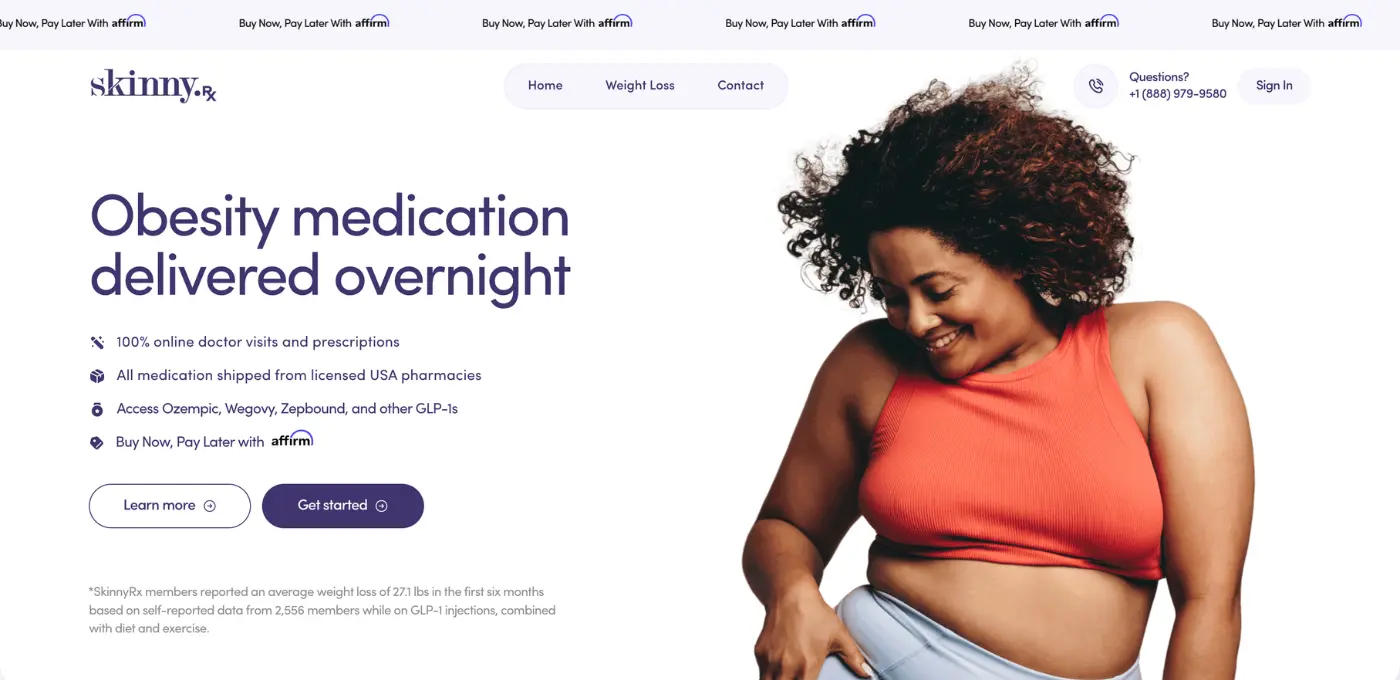
Skinny.Rx is a telehealth platform focused exclusively on GLP-1 weight loss medications. Offering compounded semaglutide and tirzepatide at competitive prices, Skinny.Rx provides a streamlined online process with free consultations and shipping across all 50 states.
TL;DR: Skinny.Rx is a legitimate prescription weight loss platform in a search category dominated by supplements and unregulated products - it offers compounded semaglutide and tirzepatide from licensed providers at competitive prices, and explicitly positions itself against the supplement industry that borrows medical language without medical substance. If you found Skinny.Rx while searching for weight loss medication and are not sure whether it is a real prescription service, it is. Best for people searching broadly for weight loss medication who want to confirm they are accessing actual clinical treatment.
Our Verdict
Skinny.Rx delivers on its core promise: prescription GLP-1 access at a competitive price with appropriate clinical oversight. The monthly check-in structure, 503B facility sourcing, and transparent pricing make it a credible option in the compounded semaglutide market. The prescription-forward brand identity is not marketing noise - it signals a genuine commitment to medical legitimacy that distinguishes the platform from supplement brands misusing GLP-1 language.
The platform is right for self-directed patients who want medication access with clinical supervision and do not need structured behavioral support. It is less right for patients with complex health presentations or those who need intensive lifestyle coaching to complement the medication. Within its lane, Skinny.Rx executes well.
Skinny.Rx Pros & Cons
Pros
✓Competitive pricing on GLP-1 medications
✓Simple, streamlined online process
✓Available in all 50 states
✓Free consultation and shipping included
✓HSA/FSA cards accepted for payment
Cons
✗Weight loss is the only treatment category offered
Medical Disclaimer: Content is for informational purposes only - not medical advice. Consult a licensed healthcare provider before any treatment. Learn more
Skinny.Rx Treatments & Pricing
GLP-1 Weight Loss
From $149/month
Skinny.Rx offers compounded GLP-1 medications including semaglutide and tirzepatide for medically supervised weight loss. Treatment includes an online consultation with a licensed provider, personalized dosing, and monthly medication delivery.
Individual results may vary. Results depend on many factors including adherence to treatment, individual health conditions, and other medications. The information above represents typical ranges based on clinical studies and manufacturer data, not guaranteed outcomes.
Money-Saving Tips for Skinny.Rx
Here's what you can actually do to lower your Skinny.Rx cost, based on what they publish about pricing and payment options.
Current Promotion
Here's what Skinny.Rx is promoting right now: "25% Lower Prices on All GLP-1s - Semaglutide From $149.25/mo." Promotions and terms change, so confirm the details at checkout before you commit.
HSA/FSA Eligibility
Skinny.Rx accepts HSA and FSA payment, so you may be able to put pre-tax money toward eligible treatments. Whether a specific treatment qualifies depends on your plan and IRS rules, so check with your plan administrator before you count on it.
Price Range for Skinny.Rx
$149-$299/month
Actual costs depend on treatment plan, medication selection, and insurance coverage.
How Skinny.Rx Works
1Complete a brief online health questionnaire about your weight loss goals and medical history.
2A licensed healthcare provider reviews your information and determines if GLP-1 medication is appropriate.
3If prescribed, your compounded medication is shipped directly to your door with free shipping.
4Follow your personalized dosing schedule with ongoing provider support and monthly refills.
About This Comparison
Our Editorial Standards
This weight loss provider comparison is independently researched by our editorial team. We compare telehealth services based on publicly available information including pricing, available treatments, and service areas. Our ratings are editorial judgments, not tallies of reviews.
Independent Research: We do not accept payment for rankings or favorable reviews
Affiliate Disclosure: We may earn commissions from qualifying purchases at no extra cost to you
Regular Updates: Content is reviewed and updated monthly for accuracy
Licensed Providers Only: All listed services employ US-licensed healthcare providers
Not Medical Advice: This comparison is for informational purposes only. We are not healthcare providers. Always consult with a licensed physician before starting any treatment. Read our full medical disclaimer and editorial policy.
Independent ResearchNo paid placements
Fact-Checked InformationVerified against official sources
Regularly UpdatedLast updated August 20, 2026
Licensed Providers OnlyAll listed services are US-licensed
Skinny.Rx In-Depth Review
Written by Eric GoldEditor-in-Chief
9 min readUpdated August 20, 2026
Skinny.Rx leads with what it is: a prescription weight loss platform. In a market saturated with supplements and herbal products that use clinical-sounding language without licensed prescribers or FDA-regulated medications, Skinny.Rx explicitly positions around real prescriptions from real providers. Compounded semaglutide and tirzepatide, FDA-registered compounding pharmacies, licensed telehealth providers. The consumer-facing branding reaches people searching broadly for weight loss solutions; the clinical model behind it is genuine. For people who encountered Skinny.Rx organically and want to know whether it is the real thing, the answer is yes.
The Prescription-Forward Positioning
Skinny.Rx entered the telehealth weight loss market at a moment when confusion between legitimate GLP-1 prescriptions and unregulated "semaglutide supplements" was at a peak. Several companies were selling oral capsules, troches, or nasal sprays marketed as semaglutide alternatives that contained no actual semaglutide or contained it in forms with no clinical evidence. The FDA issued multiple warnings about these products.
Against that backdrop, Skinny.Rx's explicit prescription identity serves a real purpose. When the name itself contains .Rx, the platform is making a claim about regulatory legitimacy that separates it from supplement brands. The medication is compounded semaglutide or tirzepatide prescribed by a licensed provider after a clinical evaluation, dispensed by a licensed 503B compounding pharmacy, and administered as a subcutaneous injection - the same route of administration as the branded versions.
The platform's intake reinforces this framing. The health history form asks about cardiovascular risk factors, existing medications, contraindications, and prior weight loss treatments. It screens for patients who should not use GLP-1 medications. This is the clinical process, not a formality to get through before receiving a predetermined prescription.
Tirzepatide - the dual GLP-1/GIP agonist - is also available at Skinny.Rx. Clinical data from the SURMOUNT-1 trial demonstrated average weight loss of 20.9% of body weight over 72 weeks at the highest dose, compared to 14.9% for semaglutide. Tirzepatide is typically recommended for patients who have not achieved sufficient response on semaglutide, or as a first-line option for patients with specific metabolic profiles.
The dosing decisions at Skinny.Rx are made during monthly provider check-ins. Providers have discretion to slow the titration schedule for patients experiencing significant GI side effects, and to accelerate it for patients who are tolerating the current dose well with limited weight loss response. This individualization within the standard protocol is what distinguishes medically supervised compounding platforms from simply ordering medication from a pharmacy.
Each shipment includes injection training materials. The auto-injection pen format used by most 503B compounding pharmacies simplifies the self-injection process considerably - there is no drawing from a vial, no manual dose measurement, and the needle is short enough that most patients find the process much less intimidating than anticipated.
Pricing Structure
Skinny.Rx's starting prices are $149.25 per month for compounded injectable semaglutide and $224.25 per month for tirzepatide tablets, the figures shown on this page, price-verified August 21, 2026. Read "from" literally. Skinny.Rx does not publish a dose-by-dose ladder on any page we could verify, so what a higher dose costs is not something you can look up before you sign up, and the quote after your provider evaluation is the real number.
The monthly fee covers medication, shipping, and monthly provider check-in. No separate consultation fees are charged, and messaging support between check-ins is included. What a higher dose costs is not published, so you do not know the full price until Skinny.Rx quotes it.
For context: Wegovy is the brand-name product, and what you would pay for it depends on your insurance and where you fill it. The clinical evidence for semaglutide's weight loss efficacy was established with the branded medication, but the active ingredient in Skinny.Rx's compounded formulation is chemically identical semaglutide manufactured under FDA-oversight at a 503B facility. The cost difference reflects the different manufacturing and distribution model, not a difference in the active molecule.
Skinny.Rx accepts HSA and FSA payments, which reduces effective cost for patients with pre-tax health savings accounts. The platform does not bill insurance, consistent with the standard for compounded medication platforms.
Ready to Start With Skinny.Rx?
1
Limited Offer
Licensed US healthcare providers
Personalized treatment plans
Free discreet shipping
9.0
ExcellentScore based on review by ManyTreatments editors, popularity, brand reputation, features and benefitsLearn how we score
All compounded medications at Skinny.Rx are sourced from FDA-registered 503B outsourcing facilities. This regulatory framework was established by the Drug Quality and Security Act of 2013 specifically to create a higher standard for compounding pharmacies that produce medications in larger quantities for distribution rather than compounding for individual patient prescriptions.
503B facilities are subject to mandatory FDA registration, periodic unannounced FDA inspections, and must follow current Good Manufacturing Practice regulations. They must test each batch for identity, strength, quality, and purity. The sterility requirements for injectable products are particularly stringent because the consequences of contamination for subcutaneous injections are serious.
This is the meaningful quality distinction in the compounded GLP-1 market. 503A compounding pharmacies - which compound for individual prescriptions - have much lower regulatory requirements. An injectable medication compounded by a 503A pharmacy does not carry the same quality assurance as one produced by a 503B facility under cGMP standards.
Skinny.Rx's choice to source exclusively from 503B facilities reflects a clinical quality commitment that not every compounded GLP-1 platform makes. When evaluating compounded semaglutide or tirzepatide from any platform, asking about the sourcing facility's 503B registration status is the single most important quality question you can ask.
Who Skinny.Rx Is Right For
Skinny.Rx serves patients who want prescription weight loss medication delivered through a clinically appropriate process at a price that makes long-term treatment financially realistic.
The strongest fit is for adults who: have a BMI of 30 or higher (or BMI 27+ with a comorbidity), have done sufficient research to understand how GLP-1 medications work and what to expect from treatment, are comfortable with weekly self-injection after training, and want a platform that is direct about being a prescription medication service rather than a lifestyle program.
The platform is less appropriate for patients who need extensive hand-holding through the dietary and behavioral changes that complement GLP-1 medication. The medication dramatically reduces appetite and supports weight loss, but patients who make no dietary changes typically see limited results. Skinny.Rx provides guidance on dietary patterns that work with GLP-1 treatment, but not structured one-on-one nutrition coaching.
Patients with diabetes, kidney disease, or complex cardiovascular histories benefit from more intensive clinical monitoring than a monthly check-in structure provides. For those presentations, a platform with integrated lab monitoring or a primary care telehealth provider like PlushCare that can manage the full clinical picture may be more appropriate.
Skinny.Rx competes directly with Shed, iVIM Health, and other compounded GLP-1 platforms that lead on price and medication access rather than program depth. At comparable pricing with monthly check-ins included, the differentiation comes down to smaller details: the quality of the provider network, 503B facility reliability, shipping consistency, and the responsiveness of the messaging support between check-ins.
Against hims and Ro Body, Skinny.Rx offers comparable or lower pricing with similar clinical oversight. Ro Body includes more structured lifestyle support (nutrition counseling, exercise guidance) but charges more. hims offers branded and compounded options but at higher price points for comparable medication access.
Against Eden Health and similar platforms, Skinny.Rx's positioning is similar - the differentiators are brand identity and specific execution rather than structural program differences.
The most useful comparison for any patient choosing between compounded GLP-1 platforms is to ask about 503B facility sourcing (non-negotiable for safety), monthly vs quarterly check-in frequency (meaningful for titration-phase support), and the responsiveness of the messaging system for between-check-in questions. On all three dimensions, Skinny.Rx performs competently.
Ready to Start With Skinny.Rx?
1
Limited Offer
Licensed US healthcare providers
Personalized treatment plans
Free discreet shipping
9.0
ExcellentScore based on review by ManyTreatments editors, popularity, brand reputation, features and benefitsLearn how we score
The .Rx signifies prescription medication - Skinny.Rx provides actual prescription GLP-1 medications (compounded semaglutide and tirzepatide) prescribed by licensed providers, not supplements or over-the-counter products.
How much does Skinny.Rx cost?
Skinny.Rx's starting prices are $149.25 per month for compounded injectable semaglutide and $224.25 per month for tirzepatide tablets, price-verified August 21, 2026. Skinny.Rx does not publish what a higher dose costs, so the quote after your provider evaluation is the real number.
Is the semaglutide from Skinny.Rx the same as Wegovy?
The active ingredient is chemically identical semaglutide, but it is compounded by a 503B facility rather than manufactured by Novo Nordisk. The mechanism and clinical effect are the same. The cost difference reflects the different manufacturing model.
How often do I check in with a provider?
Monthly check-ins are included in the subscription. Between check-ins, provider messaging is available for side effect questions and clinical concerns.
Does Skinny.Rx offer tirzepatide?
Yes. Skinny.Rx lists tirzepatide tablets from $224.25 per month, price-verified August 21, 2026, and does not publish what a higher dose costs. Clinical trial data shows tirzepatide produces greater average weight loss than semaglutide.
What 503B facility does Skinny.Rx use?
Skinny.Rx sources from FDA-registered 503B outsourcing facilities. Contact Skinny.Rx support to ask about the specific compounding partner for your prescription.
Does Skinny.Rx accept insurance?
No. Skinny.Rx is a cash-pay platform. Compounded medications are not covered by insurance. HSA and FSA cards are accepted.
Who qualifies for Skinny.Rx?
Adults with BMI 30 or higher, or BMI 27 or higher with a weight-related health condition. People with history of medullary thyroid cancer, pancreatitis, or pregnancy do not qualify.
Does Skinny.Rx provide nutrition coaching?
Skinny.Rx provides dietary guidance alongside medication but does not include structured one-on-one nutrition coaching. The platform focuses on prescription access and medical oversight.
How long until results appear?
Meaningful weight loss typically begins in weeks 4-8 as doses increase. The most significant results occur in months 4-12 at therapeutic doses. Average weight loss on semaglutide is 14.9% of body weight over 68 weeks per STEP trial data.
Can I cancel at any time?
Yes. Subscriptions can be cancelled at any time without contracts or penalties.
Is Skinny.Rx available in all states?
Skinny.Rx serves most US states. Check the Skinny.Rx website for current availability in your state.
Sources & References
Our comparisons are informed by official sources and regulatory guidelines. We encourage readers to verify information with authoritative sources.
Editorial Note: Researched and edited by our editorial team. AI tools assist with initial research and drafting; all content is fact-checked and edited by humans before publication. Learn more about our editorial standards
Is Skinny.Rx Legit?
We checked their medical licenses and pharmacy certifications.
Regulatory noticeRegulatory note (verified August 22, 2026): Skinny.Rx operates as SkinnyRx, but the legal entity is Lean Rx, Inc., and that is the name on FDA warning letter MARCS-CMS 717989, dated February 20, 2026. Following a December 2025 review of skinnyrx.com, the agency objected to the "SkinnyRx" name on pictured labels, saying it implies SkinnyRx compounds the drugs itself, and to three marketing lines, including "Get access to the same active ingredient as name-brand GLP-1 medications" and "It contains the same active ingredient as FDA-approved medications." Compounded semaglutide and tirzepatide are not FDA-approved, so the FDA read those lines as implying an approval that does not exist and classed the products as misbranded. No close-out letter is posted; read the matter as unresolved. Read the FDA letter
Compare Skinny.Rx to Alternatives
See how Skinny.Rx stacks up against other popular telehealth providers. Compare pricing, services, and our editorial ratings to find the best option for your needs.
Eric Gold is a writer and editor with a background in digital media and consumer research. He has spent the last several years covering the health and wellness industry, with a particular focus on telehealth services and direct-to-consumer healthcare. Eric believes that access to clear, unbiased information should not require a medical degree. When he is not reviewing telehealth platforms, he enjoys hiking, cooking, and following the stock market a little too closely.
Medical Disclaimer: This review is for informational purposes only and is not a substitute for professional medical advice. Always consult with a licensed healthcare provider before starting any treatment. Individual results may vary. We may receive compensation through affiliate links, which helps support our research and content.