
Is Skinny.Rx Legit? Testing the Money-Back GLP-1 Guarantee
Trust & Safety Review
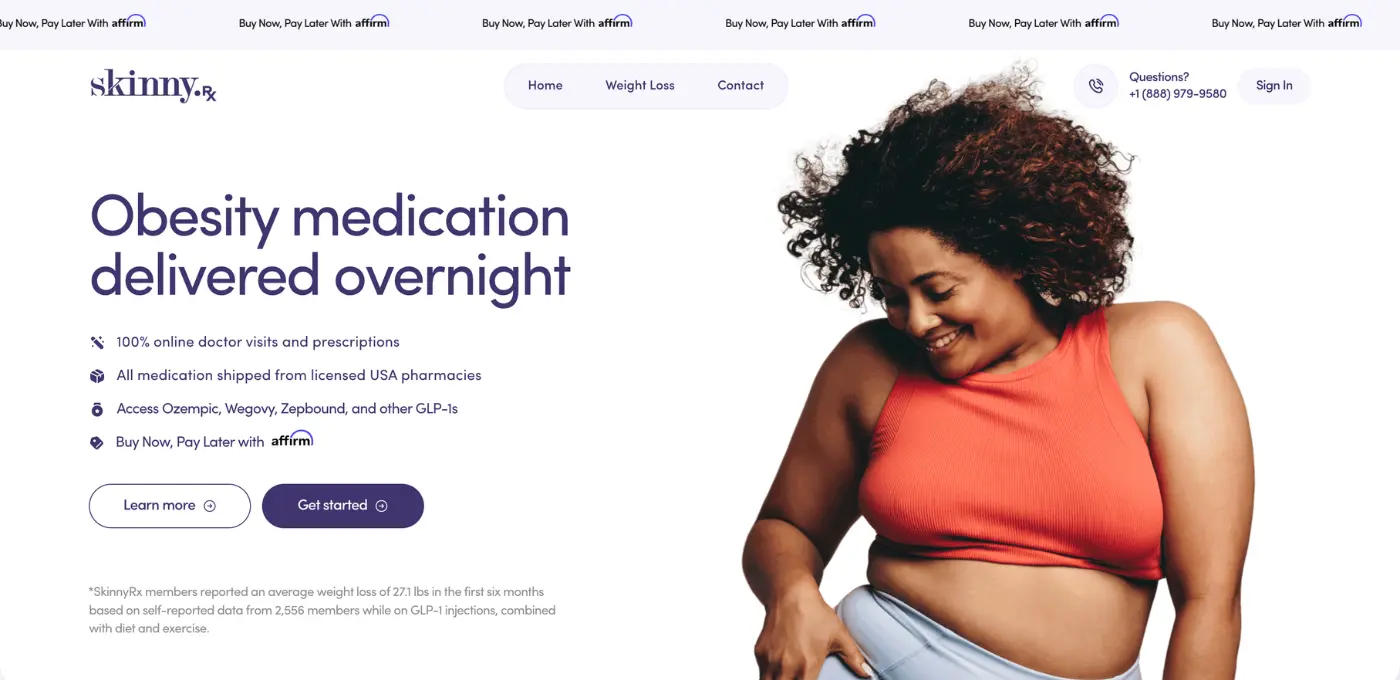
Skinny.Rx entered the competitive GLP-1 market in 2023 with a rare offering: a money-back guarantee on their weight loss program. While most telehealth platforms offer no refunds on medication, Skinny.Rx bets on their treatment working. They're the newest platform we evaluate. We analyzed their guarantee terms, pharmacy sourcing, and early patient feedback.
Our editorial rating9/10
Founded2024
Categories1 treatments
Skinny.Rx Pros & Cons
Pros
- ✓Competitive pricing on GLP-1 medications
- ✓Simple, streamlined online process
- ✓Available in all 50 states
- ✓Free consultation and shipping included
- ✓HSA/FSA cards accepted for payment
Cons
- ✗Weight loss is the only treatment category offered
- ✗Newer company with a limited track record
- ✗No mobile app available
- ✗Does not accept insurance
Medical Disclaimer: Content is for informational purposes only - not medical advice. Consult a licensed healthcare provider before any treatment. Learn more
Try Skinny.Rx Today
25% Lower Prices on All GLP-1s - Semaglutide From $149.25/mo
- Compounded injectable semaglutide from $149.25/mo, tirzepatide tablets from $224.25/mo
- FDA-approved Wegovy® and other GLP-1s available, plus daily oral options via membership
- Clinician-guided care, not just a prescription - ongoing dose adjustments and provider check-ins
- App with care team support, medication reminders and weight trend tracking
About This Comparison
Our Editorial Standards
This weight loss provider comparison is independently researched by our editorial team. We compare telehealth services based on publicly available information including pricing, available treatments, and service areas. Our ratings are editorial judgments, not tallies of reviews.
Independent Research: We do not accept payment for rankings or favorable reviews
Affiliate Disclosure: We may earn commissions from qualifying purchases at no extra cost to you
Regular Updates: Content is reviewed and updated monthly for accuracy
Licensed Providers Only: All listed services employ US-licensed healthcare providers
Not Medical Advice: This comparison is for informational purposes only. We are not healthcare providers. Always consult with a licensed physician before starting any treatment. Read our full medical disclaimer and editorial policy.
Independent ResearchNo paid placements
Fact-Checked InformationVerified against official sources
Regularly UpdatedLast updated August 22, 2026
Licensed Providers OnlyAll listed services are US-licensed

Who Owns Skinny.Rx and Are They a Real Company?
Yes, Skinny.Rx is a legitimate telehealth company that has been operating since 2023. Headquartered in Los Angeles, CA, Skinny.Rx provides treatments in Weight Loss, serving patients across the United States through licensed healthcare providers. Skinny.Rx entered the GLP-1 market in 2023 with aggressive pricing and a money-back guarantee on their weight loss program — a guarantee that most competitors do not offer, providing a safety net for patients unsure about trying GLP-1
Founded in 2023, Skinny.Rx has attracted investor confidence in the competitive telehealth market, securing the funding needed to build out their technology platform, provider network, and pharmacy partnerships. While newer than some established competitors, Skinny.Rx's business model has been validated by venture capital due diligence processes that evaluate regulatory compliance, market opportunity, and operational capability. All providers on the platform must maintain active licenses verified through state medical boards.
As a newer entrant in the telehealth market (founded 2023), Skinny.Rx has a shorter track record than established competitors. This is common for recently established companies and does not indicate negative findings. Weigh the limited track record against other trust signals such as pharmacy licensing, provider credentials verified through the FSMB, and early reviews on Trustpilot. You can check the current profile at the Better Business Bureau.
Skinny.Rx is a newer platform with a still-limited independent review record. Early reviews can be informative but should be interpreted with appropriate caution.
Skinny.Rx offers treatments across 1 category: Weight Loss. This focused specialization allows the company to concentrate its medical expertise, technology investment, and customer service resources on a single treatment area, potentially delivering deeper expertise than broader platforms. The company's treatment offerings match standard telehealth practice in their respective categories.
How Does Skinny.Rx Work? Step-by-Step Process
Skinny.Rx follows a structured telehealth process designed to deliver prescription treatment safely and conveniently. You visit skinnyrx.com and complete a health intake form covering your weight history, medical conditions, current medications, and weight loss goals. A licensed physician reviews your submission and determines GLP-1 eligibility. If approved, your compounded semaglutide or tirzepatide ships from a partner pharmacy. The key differentiator: Skinny.Rx's money-back guarantee means if you follow the program and do not see results within the specified timeframe, you can request a refund per their terms and conditions.
The initial health assessment is a critical component of the Skinny.Rx process, serving as the foundation for safe prescribing decisions. Telehealth health assessments must collect sufficient information for providers to make informed prescribing decisions without an in-person examination. This includes current medications, allergies, relevant medical history, and contraindication screening specific to the requested treatment. Patients should answer all health questions honestly and completely, as inaccurate information could lead to inappropriate prescriptions or missed safety concerns. The Ryan Haight Act requires that telehealth prescribers maintain appropriate provider-patient relationships for controlled substance prescribing.
Once a provider approves your treatment, Skinny.Rx coordinates prescription fulfillment through their pharmacy network. Skinny.Rx partners with FDA-registered compounding pharmacies for semaglutide and tirzepatide preparation. As a newer platform, their pharmacy partnerships are more recently established. Their compounding partners follow cGMP standards and conduct standard potency and sterility testing on medication batches. The prescription-to-delivery timeline varies based on medication type and shipping method, but patients can generally expect to receive their first order within one to two weeks of initial consultation approval. Subsequent refills are typically faster as the pharmacy already has your prescription on file. All pharmacy partners must comply with state board of pharmacy regulations.
Follow-up care is an essential component of responsible telehealth practice, and Skinny.Rx provides ongoing access to licensed providers after the initial consultation. For ongoing treatments, Skinny.Rx schedules regular provider check-ins to monitor treatment efficacy, manage side effects, and adjust dosing as needed. This follow-up cadence is particularly important for treatments with dose-escalation protocols, such as GLP-1 weight loss medications, where provider oversight at each dose increase is a standard safety requirement. The HHS telehealth policy framework outlines best practices for ongoing telehealth care management.
Skinny.Rx ships GLP-1 medications from their compounding pharmacy partners with free standard shipping. Delivery typically takes 5-7 business days for initial orders, with monthly refills shipped automatically. All medications are shipped in discreet packaging with no visible treatment information on the exterior, protecting patient privacy during delivery. Patients should ensure they provide accurate shipping information and are available to receive temperature-sensitive medications promptly, as some treatments (particularly injectable GLP-1 medications) require proper storage upon arrival. For information on HIPAA protections covering your health data during the shipping process, refer to the privacy section below.
Are Skinny.Rx's Doctors Real and Licensed?
Yes, Skinny.Rx uses real, licensed healthcare providers for all medical consultations and prescriptions. Skinny.Rx employs licensed physicians who specialize in weight management. As a newer platform, their provider team is smaller but focused exclusively on GLP-1 prescribing. All providers on the Skinny.Rx platform must maintain active, unrestricted medical licenses in the states where they practice, which can be independently verified through state medical board databases.
State medical licensing is the primary safeguard ensuring telehealth provider quality. Each state maintains a medical board that issues, renews, and monitors physician licenses, and patients can verify any provider's license status through these public databases maintained by the Federation of State Medical Boards. Skinny.Rx is responsible for verifying that every provider on their platform holds current, unrestricted licenses in the states where they treat patients. This verification process includes confirming medical school graduation, residency completion, board certification status through the American Board of Medical Specialties, and absence of disciplinary actions. Patients who wish to verify their provider's credentials independently can search the FSMB's DocInfo database or their specific state's medical board website.
The Ryan Haight Online Pharmacy Consumer Protection Act of 2008 establishes federal requirements for prescribing controlled substances via telehealth. This law requires that at least one in-person or qualifying telehealth evaluation occur before a controlled substance can be prescribed. For non-controlled medications (which constitute the majority of treatments prescribed by platforms like Skinny.Rx), standard telehealth prescribing regulations apply. These regulations require providers to conduct an adequate evaluation, establish a provider-patient relationship, and maintain appropriate medical records. The DEA has established specific pathways for telehealth prescribing that Skinny.Rx must follow.
Skinny.Rx's provider model emphasizes specialization in Weight Loss, which means their physicians and nurse practitioners develop concentrated expertise in the specific conditions they treat. This focused approach can lead to better patient outcomes, as providers who treat the same conditions daily develop pattern recognition and nuanced clinical judgment that generalists may lack. Patients should feel empowered to ask their Skinny.Rx provider about their specific qualifications and experience with the requested treatment. Provider board certifications can be verified at the ABMS.
Patients can take several steps to verify the legitimacy of their healthcare provider, whether through Skinny.Rx or any telehealth platform. First, check the provider's license status through the state medical board where they practice. Second, verify their National Provider Identifier (NPI) through the NPPES NPI Registry at npiregistry.cms.hhs.gov. Third, check for any disciplinary actions through the National Practitioner Data Bank. Fourth, confirm board certification through the American Board of Medical Specialties at certificationmatters.org. These verification steps are free, publicly accessible, and provide independent confirmation of a provider's credentials beyond what any telehealth platform reports.
Is Skinny.Rx FDA-Approved? Pharmacy and Medication Quality
Skinny.Rx prescribes compounded medications, which are prepared by FDA-registered compounding pharmacies rather than manufactured by pharmaceutical companies. This is an important distinction: while the active pharmaceutical ingredients in compounded medications are FDA-approved, the specific compounded formulations have not undergone individual FDA clinical trials. This is standard practice for all compounded medications across the healthcare industry — not unique to Skinny.Rx — and is regulated under federal and state pharmacy law.
Compounding pharmacies operate under two primary regulatory categories: 503A and 503B. Section 503A pharmacies compound individual patient prescriptions based on a licensed prescriber's order — these are traditional compounding operations similar to what hospital pharmacies have done for decades. Section 503B pharmacies are outsourcing facilities that can compound in larger batches and must register with the FDA, follow current Good Manufacturing Practice (cGMP) standards, and submit to FDA inspection. Skinny.Rx's pharmacy partners operate under these regulatory frameworks with appropriate state and federal oversight.
Skinny.Rx partners with FDA-registered compounding pharmacies for semaglutide and tirzepatide preparation. As a newer platform, their pharmacy partnerships are more recently established. Their compounding partners follow cGMP standards and conduct standard potency and sterility testing on medication batches. Quality control in pharmaceutical dispensing involves multiple checkpoints: verification of prescription accuracy, drug interaction screening, patient allergy checks, and proper medication storage and handling. For compounded medications specifically, potency testing verifies that the correct amount of active ingredient is present in each dose, and sterility testing (for injectable medications like GLP-1s) confirms the absence of microbial contamination. These tests are performed on each batch before any medication is dispensed to patients.
Patients should understand the regulatory market of their specific medications when evaluating any telehealth platform. For compounded medications like those offered by Skinny.Rx, the key questions to ask are: Is the compounding pharmacy FDA-registered? Do they follow cGMP standards? Do they test each batch for potency and sterility? Are they licensed by their state board of pharmacy? Affirmative answers to these questions indicate a compliant compounding operation. Patients can verify pharmacy registration through the FDA's database.
The broader telehealth medication market is evolving, with the FDA, DEA, and state pharmacy boards continuously updating regulations to address new delivery models. Skinny.Rx operates within this regulatory framework, and patients can independently verify compliance through public databases maintained by the FDA (pharmacy registration), DEA (controlled substance licensing), and state boards of pharmacy (dispensing authorization). These verification tools are freely available online and provide patients with the means to confirm that their medication source meets all applicable regulatory standards.
What Do Real Patients Say About Skinny.Rx?
Skinny.Rx holds a 9.0 (Excellent) rating in our ratings.
You can read current, unfiltered patient feedback on Trustpilot, and recent reviews deserve more weight than older ones. We do not quote third-party review statistics we cannot verify; our own 9.0 (Excellent) rating reflects our editorial assessment of pricing, transparency, and service quality.
Start with dates when you read Skinny.Rx's reviews, or any telehealth platform's. Feedback from the past six months describes how the company operates now, while older entries may describe something that has changed. Then read the spread, because mostly 5-star and 1-star reviews tell a different story than reviews clustered around 4 stars. Skinny.Rx works in GLP-1 weight loss, where what someone paid and what dose they were on shape the account, so read the detail rather than the star rating.
Common positive themes in Skinny.Rx reviews include money-back guarantee, aggressive GLP-1 pricing, newer platform with growth focus, and the effectiveness of treatments offered. These positive patterns are consistent with the platform's stated value proposition and suggest that Skinny.Rx delivers on its core promises for the majority of patients. However, no telehealth platform achieves 100% satisfaction, and understanding the common complaints is equally important for setting realistic expectations.
Independent review platforms like Trustpilot and the Better Business Bureau provide unfiltered patient feedback that company marketing cannot replicate. We recommend checking these sources directly before making a healthcare decision, paying particular attention to reviews from the past 6 months and filtering for reviews that discuss your specific treatment category. Skinny.Rx is still building their BBB profile, so Trustpilot and other review platforms are currently the primary sources of independent patient feedback.
How Much Does Skinny.Rx Cost and Are There Hidden Fees?
Skinny.Rx's pricing is structured as follows: Compounded Semaglutide: from $149/month. Compounded Tirzepatide: from $199/month. These prices represent the platform's current listed rates and include the base cost of treatment. Whether additional fees apply depends on the specific treatment plan and payment structure. Understanding the complete cost picture requires examining not just the headline price but also consultation fees, shipping costs, and any recurring charges.
Skinny.Rx is cash-pay only. Their pricing is competitive in the compounded GLP-1 market. HSA/FSA payments accepted.. For GLP-1 weight loss treatment specifically, compounded semaglutide and tirzepatide pricing at telehealth platforms reflects the cost of compounding pharmacy preparation, provider consultations, and ongoing monitoring, not just the active ingredient. Brand-name GLP-1 medications (Wegovy, Ozempic, Zepbound, Mounjaro) are cheaper to self-pay than they used to be: Novo Nordisk's NovoCare Pharmacy lists Wegovy at $199 a month for your first two fills and $349 a month after that, and Lilly's LillyDirect lists the Zepbound KwikPen or vial at $299 a month, both verified September 2026. Compare any compounded plan against those cash prices rather than against an insurer list price.
Hidden fee analysis: Skinny.Rx does not charge cancellation fees. Based on our analysis and patient review data, Skinny.Rx's pricing is generally transparent with the listed rates reflecting the actual out-of-pocket cost. Patients should confirm the total cost during their consultation, including any ancillary fees for shipping upgrades, expedited processing, or add-on services.
Payment options at Skinny.Rx include standard credit and debit cards. HSA (Health Savings Account) and FSA (Flexible Spending Account) payments are accepted for eligible treatments, which can provide tax advantages of 20-35% depending on your tax bracket. To use HSA/FSA funds, patients typically need to pay with their HSA/FSA debit card or submit receipts for reimbursement. Some platforms also offer financing options through third-party providers like Affirm or CareCredit for patients who prefer to spread payments over several months.
When comparing Skinny.Rx's pricing to competitors, it is important to compare equivalent services rather than just headline numbers. A lower per-month price that excludes consultation fees, shipping, or dose adjustment charges may not be cheaper than a higher all-inclusive price. Skinny.Rx's pricing covers the stated services at the listed rates, with patients responsible for any additional costs such as pharmacy dispensing fees or shipping upgrades. We recommend requesting a complete cost breakdown before starting treatment with any telehealth platform.
Does Skinny.Rx Accept Insurance or HSA/FSA?
Skinny.Rx is cash-pay only. Their pricing is competitive in the compounded GLP-1 market. HSA/FSA payments accepted. Because Skinny.Rx does not bill insurance, you pay the listed cash price and there is no claim to submit.
For patients with Health Savings Accounts (HSA) or Flexible Spending Accounts (FSA), Skinny.Rx accepts these payment methods for eligible treatments. HSA and FSA accounts allow patients to pay for qualified medical expenses with pre-tax dollars, effectively reducing the cost by 20-35% depending on the patient's tax bracket. Detailed information about health savings and flexible spending accounts and eligible expenses is available from the IRS in Publication 969. Understanding the tax-advantaged payment options available can significantly change the real cost of treatment.
Skinny.Rx's insurance coordination process works as follows: during signup, you provide your insurance information, and Skinny.Rx verifies your coverage and benefits. For covered services, Skinny.Rx submits claims directly to your insurance company, and you are responsible for any copay, coinsurance, or deductible amounts based on your plan. Processing times vary by insurer but typically take 1-2 weeks for verification. If your insurance does not cover a specific treatment, Skinny.Rx offers cash-pay alternatives at their listed prices.
Patients considering Skinny.Rx should also explore manufacturer savings programs, patient assistance programs, and generic alternatives that can reduce out-of-pocket costs regardless of insurance status. For weight loss specifically, brand-name GLP-1 manufacturers (Novo Nordisk for Wegovy/Ozempic, Eli Lilly for Zepbound/Mounjaro) offer savings cards for commercially insured patients that can reduce copays significantly. Compounded alternatives like those offered by many telehealth platforms provide a more affordable option for patients without GLP-1 insurance coverage.
The insurance market for telehealth is evolving rapidly, with more insurers covering virtual visits following pandemic-era policy changes as outlined by HHS telehealth policy. Skinny.Rx's existing insurance acceptance positions them well as coverage expands. Patients should periodically check with their insurer about new telehealth benefits, as plans update coverage annually. The American Telemedicine Association tracks federal and state telehealth policy activity. The Consolidated Appropriations Act of 2023 extended telehealth flexibilities through 2025, and legislative proposals are underway to make many of these provisions permanent.
What Is Skinny.Rx's Cancellation and Refund Policy?
Cancel anytime with no fees. Month-to-month billing with no long-term contracts. Their money-back guarantee provides additional protection for new patients.. Understanding the cancellation process before signing up is essential for avoiding unexpected charges. Skinny.Rx's cancellation policy is designed to give patients flexibility, though the specific terms depend on whether you're on a monthly, quarterly, or annual plan.
Money-back guarantee: contact support if you don't see results per their terms and conditions. Monthly subscriptions cancel anytime with no fees. Standard shipped medications are non-refundable outside of the guarantee program.. Telehealth medication refunds are generally limited once medications have been shipped due to pharmaceutical regulations that prevent the resale or redistribution of dispensed medications. This is an industry-wide standard, not specific to Skinny.Rx. Skinny.Rx's money-back guarantee is a notable exception to the industry norm, providing an additional safety net for patients who do not see results under the program's stated terms and conditions.
For patients considering Skinny.Rx, we recommend the following approach to manage subscription risk. First, start with a monthly plan rather than committing to a quarterly or annual plan upfront — monthly plans cost slightly more per month but provide maximum cancellation flexibility. Second, set a calendar reminder 3-5 days before your billing date to evaluate whether you want to continue. Third, document your cancellation if you choose to cancel — take screenshots of the confirmation and note the date, method, and any reference numbers provided. These steps protect you regardless of which telehealth platform you use.
If you experience a billing dispute with Skinny.Rx, you have several resolution paths available. First, contact Skinny.Rx's customer support directly — most billing issues can be resolved at this level. Second, if direct resolution fails, file a complaint with the Better Business Bureau, which facilitates mediated dispute resolution. Third, dispute the charge with your credit card company or bank under the Fair Credit Billing Act, which provides consumer protections for unauthorized or disputed charges. Fourth, for systemic issues, file a complaint with your state's attorney general consumer protection division or the Federal Trade Commission.
What Are the Side Effects of Skinny.Rx's Treatments?
Skinny.Rx prescribes compounded semaglutide and tirzepatide from FDA-registered pharmacies. Standard GLP-1 safety screening applies: thyroid cancer history, pancreatitis, gallbladder disease. Their money-back guarantee suggests confidence in their treatment protocols. Dose escalation follows standard GLP-1 titration schedules with provider oversight.. Every medication and supplement carries potential side effects, and understanding these risks is a critical component of informed healthcare decision-making. The side effects associated with Skinny.Rx's treatments are well-documented in medical literature and are not unique to the telehealth delivery model — the same medications prescribed at a traditional doctor's office carry identical risk profiles. Complete drug safety information is available through the FDA's drug safety portal.
GLP-1 receptor agonist medications (semaglutide and tirzepatide) carry well-documented side effects that patients should anticipate. According to published clinical research, the most common side effects are gastrointestinal: nausea (affecting approximately 44% of patients in the first month), vomiting (24%), diarrhea (30%), and constipation (24%). These GI effects are typically dose-dependent and most severe during the initial weeks and at each dose escalation step. Clinical trial data demonstrates that GI side effects generally diminish significantly by week 8-12 as the body adapts. Tirzepatide studies show similar GI patterns with the dual GIP/GLP-1 mechanism. Serious but rare risks include pancreatitis, gallbladder disease, and a theoretical risk of medullary thyroid carcinoma based on rodent studies (which is why personal or family history of MTC is an absolute contraindication).
Skinny.Rx's providers are responsible for screening patients for contraindications before prescribing any treatment, following guidelines established by state medical boards and the Ryan Haight Act. This screening process includes reviewing medical history for conditions that contraindicate treatment, checking current medications for potential drug interactions, and assessing individual risk factors such as age, cardiovascular health, and organ function. Patients who experience unexpected or severe side effects should contact their provider immediately and seek emergency medical attention for symptoms such as chest pain, difficulty breathing, severe allergic reactions, or signs of pancreatitis (persistent severe abdominal pain).
Long-term safety data varies by medication class. GLP-1 receptor agonists have approximately 10 years of post-market data for diabetes. Semaglutide was FDA-approved for diabetes in 2017 and for weight loss in 2021, with ongoing long-term cardiovascular outcomes studies (SELECT trial) providing additional safety data. Ongoing post-market surveillance by the FDA monitors for rare adverse events that may not appear in clinical trials.
Patients should maintain an open line of communication with their Skinny.Rx provider regarding any side effects experienced during treatment. Reporting side effects allows providers to adjust dosing, switch medications, or add supportive treatments to manage symptoms. Patients can also report adverse events directly to the FDA through MedWatch (fda.gov/medwatch), which contributes to the post-market surveillance system that protects all patients. Documentation of side effects — including onset timing, severity, duration, and any actions taken — helps providers make informed treatment decisions.
How Does Skinny.Rx Protect Your Privacy and Data?
Skinny.Rx is HIPAA compliant. As a newer platform (2023), their data practices are still developing. Standard telehealth encryption and privacy protections apply. Patient data is not sold to third parties.. As a telehealth platform handling protected health information (PHI), Skinny.Rx is subject to the Health Insurance Portability and Accountability Act (HIPAA), which establishes national standards for the protection of individually identifiable health information. Patient data protection is a critical concern in digital healthcare, where sensitive health information is transmitted and stored electronically.
HIPAA's Privacy Rule (45 CFR Part 164) governs how covered entities and their business associates handle protected health information. For Skinny.Rx, this means implementing administrative safeguards (workforce training, access controls, audit procedures), physical safeguards (facility access controls, device security), and technical safeguards (encryption, access controls, audit logs). Violations of HIPAA can result in civil penalties ranging from $100 to $50,000 per violation (up to $1.5 million per year for repeated violations) and criminal penalties including imprisonment for knowing violations. These regulatory frameworks provide meaningful protection for patient information.
Skinny.Rx's data collection practices include medical history, current medications, health questionnaire responses, provider communications, prescription records, payment information, and usage analytics. Patients should review Skinny.Rx's privacy policy (available on their website) to understand specifically what data is collected, how it is used, who it is shared with, and how long it is retained. Key privacy policy provisions to look for include: whether health data is sold to third parties, whether data is shared with advertising networks, and what happens to your data if you cancel your account. The HealthIT.gov telehealth resource provides additional guidance on evaluating telehealth privacy practices.
Skinny.Rx's data security practices should include, at minimum, encryption of data in transit (HTTPS/TLS) and at rest, multi-factor authentication for employee access to patient records, regular security audits, and an incident response plan for potential data breaches. Patients can ask Skinny.Rx's support team about specific security certifications (such as SOC 2 Type II, HITRUST, or ISO 27001) that independently validate their data security infrastructure. HIPAA requirements set the baseline for these protections.
Patients have specific rights regarding their health data under HIPAA and state privacy laws. These include the right to access your medical records, the right to request corrections to inaccurate information, the right to receive an accounting of disclosures (who your data has been shared with), and the right to request restrictions on certain uses of your information. If you believe your privacy has been violated, you can file a complaint with the HHS Office for Civil Rights (hhs.gov/ocr) or your state's attorney general. For Skinny.Rx patients, exercising these rights typically involves contacting their support team or privacy officer as described in their privacy policy.
Is Skinny.Rx Worth It? Our Final Verdict
Skinny.Rx is the best choice for patients who want a safety net when trying GLP-1 medication for the first time. Their money-back guarantee reduces the financial risk of a treatment that costs $149+/month. The trade-off is a newer platform with limited reviews — you're essentially an early adopter. For patients with higher risk tolerance who want the guarantee protection, Skinny.Rx offers a unique value proposition. For those prioritizing established track records, Hims has years of history.. This assessment is based on analyzing Skinny.Rx's pricing structure, provider credentials, patient review patterns on Trustpilot, regulatory compliance, and competitive positioning against alternative platforms. Every telehealth platform has strengths and limitations, and the right choice depends on your individual needs, budget, and treatment preferences.
Skinny.Rx is best suited for: patients specifically seeking Weight Loss treatment who value a platform with deep specialization in their condition. Their key differentiators include money-back guarantee, aggressive GLP-1 pricing, newer platform with growth focus, which position them uniquely in the telehealth market. Patients whose needs align with these strengths will likely have the best experience with Skinny.Rx.
Key strengths: money-back guarantee; aggressive GLP-1 pricing; newer platform with growth focus. Key limitations: limited to a single treatment category, requiring additional platforms for other health needs; newer platform with limited track record and review history; the standard telehealth limitation of no in-person physical examination. These limitations are common across the telehealth industry and do not indicate problems specific to Skinny.Rx.
Overall rating: 9.0 (Excellent) in our editorial ratings, based on regulatory compliance verification, pricing analysis, and provider credentialing review. This rating is preliminary given the platform's limited history and should be re-evaluated as more patient data becomes available. We update our assessments regularly based on new patient review data, regulatory changes, and platform updates.
Before starting treatment with Skinny.Rx or any telehealth platform, we recommend the following steps. First, verify that your specific condition and desired treatment are available through the platform. Second, check current pricing directly on skinnyrx.com as rates may change. Third, review the platform's privacy policy to understand how your health data will be used per HIPAA guidelines. Fourth, prepare to answer health assessment questions honestly and completely. Fifth, keep your primary care physician informed about any telehealth treatments you begin. Verify provider credentials through the FSMB and ABMS. Informed patients who take these preparatory steps consistently report the highest satisfaction with telehealth services.
Frequently Asked Questions
Is Skinny.Rx legit?
Yes, Skinny.Rx is a legitimate telehealth company founded in 2023 and headquartered in Los Angeles, CA. Skinny.Rx entered the GLP-1 market in 2023 with aggressive pricing and a money-back guarantee on their weight loss program — a guarantee that most competitors do not offer, providing a safety net for patients unsure about trying GLP-1 medication. The company holds a 9.0 (Excellent) rating in our ratings and is still building its independent review footprint. Their provider network consists of US-licensed physicians who can be independently verified through state medical board databases. Skinny.Rx operates within the standard regulatory framework governing telehealth platforms in the United States.
Is Skinny.Rx safe to use?
Skinny.Rx prescribes medications that are well-documented in medical literature with established safety profiles. Skinny.Rx prescribes compounded semaglutide and tirzepatide from FDA-registered pharmacies. Standard GLP-1 safety screening applies: thyroid cancer history, pancreatitis, gallbladder disease. Their money-back guarantee suggests confidence in their treatment protocols. Dose escalation follows standard GLP-1 titration schedules with provider oversight. All prescribing follows standard clinical guidelines, and providers screen for contraindications and drug interactions before treatment begins. Patients should disclose their complete medical history and current medications for safe treatment decisions.
Does Skinny.Rx have real doctors?
Yes, Skinny.Rx employs real, licensed healthcare providers. Skinny.Rx employs licensed physicians who specialize in weight management. As a newer platform, their provider team is smaller but focused exclusively on GLP-1 prescribing. All providers can be independently verified through state medical board databases and the National Provider Identifier (NPI) Registry at npiregistry.cms.hhs.gov. Patients have the right to request their provider's name and license number for independent verification.
What is Skinny.Rx's refund policy?
Money-back guarantee: contact support if you don't see results per their terms and conditions. Monthly subscriptions cancel anytime with no fees. Standard shipped medications are non-refundable outside of the guarantee program. As a general rule in telehealth, medications that have been shipped cannot be returned due to pharmaceutical regulations. Skinny.Rx offers a money-back guarantee under specific terms — review the guarantee conditions on their website before relying on this protection.
Does Skinny.Rx protect my personal data?
Skinny.Rx is HIPAA compliant. As a newer platform (2023), their data practices are still developing. Standard telehealth encryption and privacy protections apply. Patient data is not sold to third parties. Skinny.Rx is required to comply with HIPAA's Privacy Rule (45 CFR Part 164), which mandates administrative, physical, and technical safeguards for protected health information. Patients can review Skinny.Rx's full privacy policy on their website and have the right to request an accounting of how their data has been used and shared. If you believe your privacy has been violated, you can file a complaint with the HHS Office for Civil Rights.
Is Skinny.Rx worth the money?
Skinny.Rx is the best choice for patients who want a safety net when trying GLP-1 medication for the first time. Their money-back guarantee reduces the financial risk of a treatment that costs $149+/month. The trade-off is a newer platform with limited reviews — you're essentially an early adopter. For patients with higher risk tolerance who want the guarantee protection, Skinny.Rx offers a unique value proposition. For those prioritizing established track records, Hims has years of history. The value assessment ultimately depends on your individual circumstances: if your insurance is accepted, the cost comparison strongly favors telehealth convenience. As a newer platform, the limited track record is a consideration — established alternatives offer more social proof but may not match Skinny.Rx's specific features.
How long does Skinny.Rx take to ship?
Skinny.Rx ships GLP-1 medications from their compounding pharmacy partners with free standard shipping. Delivery typically takes 5-7 business days for initial orders, with monthly refills shipped automatically. Initial orders may take slightly longer than refills as the prescription must be verified and fulfilled for the first time. For temperature-sensitive medications (such as injectable GLP-1s), ensure someone is available to receive the package and store it appropriately upon arrival.
Does Skinny.Rx accept insurance?
Skinny.Rx is cash-pay only. Their pricing is competitive in the compounded GLP-1 market. HSA/FSA payments accepted. Check with Skinny.Rx directly to confirm your specific plan is accepted, as insurance networks vary by state and plan type.
Sources & References
Our comparisons are informed by official sources and regulatory guidelines. We encourage readers to verify information with authoritative sources.
- FSMB - Federation of State Medical BoardsState medical board licensing verification and physician lookup
- Trustpilot - Skinny.Rx Customer ReviewsVerified patient reviews of Skinny.Rx telehealth services on Trustpilot
- Better Business BureauBusiness trust ratings, complaint history, and accreditation status
- Ryan Haight Act
- NABP - National Association of Boards of PharmacyNABP accreditation standards for licensed pharmacies and compounding facilities
- HHS - Federal Telehealth PolicyFederal telehealth regulations and guidelines
- HHS - HIPAA Privacy StandardsHealth Insurance Portability and Accountability Act privacy regulations
- ABMS - American Board of Medical SpecialtiesBoard certification standards for physicians
- FDA - Drug Safety and AvailabilityFDA drug safety communications and availability updates
- TrustpilotIndependent consumer review platform with verified purchase reviews
- FDA Wegovy Prescribing InformationOfficial FDA-approved semaglutide prescribing information
- IRS Publication 969 - HSA and FSA Eligible ExpensesIRS guide to health savings accounts and eligible medical expense deductions
- FDA - Generic Drug StandardsFDA requirements for generic medication equivalence
- American Telemedicine AssociationTelehealth industry standards, guidelines, and best practices
- PMC - Semaglutide Comprehensive ReviewSystematic review of semaglutide efficacy and safety for weight loss
- PMC - Semaglutide vs Tirzepatide Clinical ComparisonHead-to-head comparison showing 15-22% weight loss efficacy
- FDA through MedWatch
- HealthIT.gov telehealth resource
Editorial Note: Researched and edited by our editorial team. AI tools assist with initial research and drafting; all content is fact-checked and edited by humans before publication. Learn more about our editorial standards
Ready to Get Started?
25% Lower Prices on All GLP-1s - Semaglutide From $149.25/mo
- Compounded injectable semaglutide from $149.25/mo, tirzepatide tablets from $224.25/mo
- FDA-approved Wegovy® and other GLP-1s available, plus daily oral options via membership
- Clinician-guided care, not just a prescription - ongoing dose adjustments and provider check-ins
- App with care team support, medication reminders and weight trend tracking
Compare Skinny.Rx to Alternatives
See how Skinny.Rx stacks up against other popular telehealth providers. Compare pricing, services, and our editorial ratings to find the best option for your needs.



Medical Disclaimer: This review is for informational purposes only and does not constitute medical advice. All information presented is based on publicly available data and our independent research. Always consult with a qualified healthcare provider before making decisions about your health or treatment options.