Choosing between Peter MD and Sprout Health depends on what you're trying to solve. Peter MD covers men's sexual health, testosterone and weight loss, while Sprout Health does weight loss only, with compounded semaglutide and tirzepatide. Weight loss is where the two overlap, and that is what this compares: price, what each one prescribes, and how you get it.
Overview of Peter MD and Sprout Health
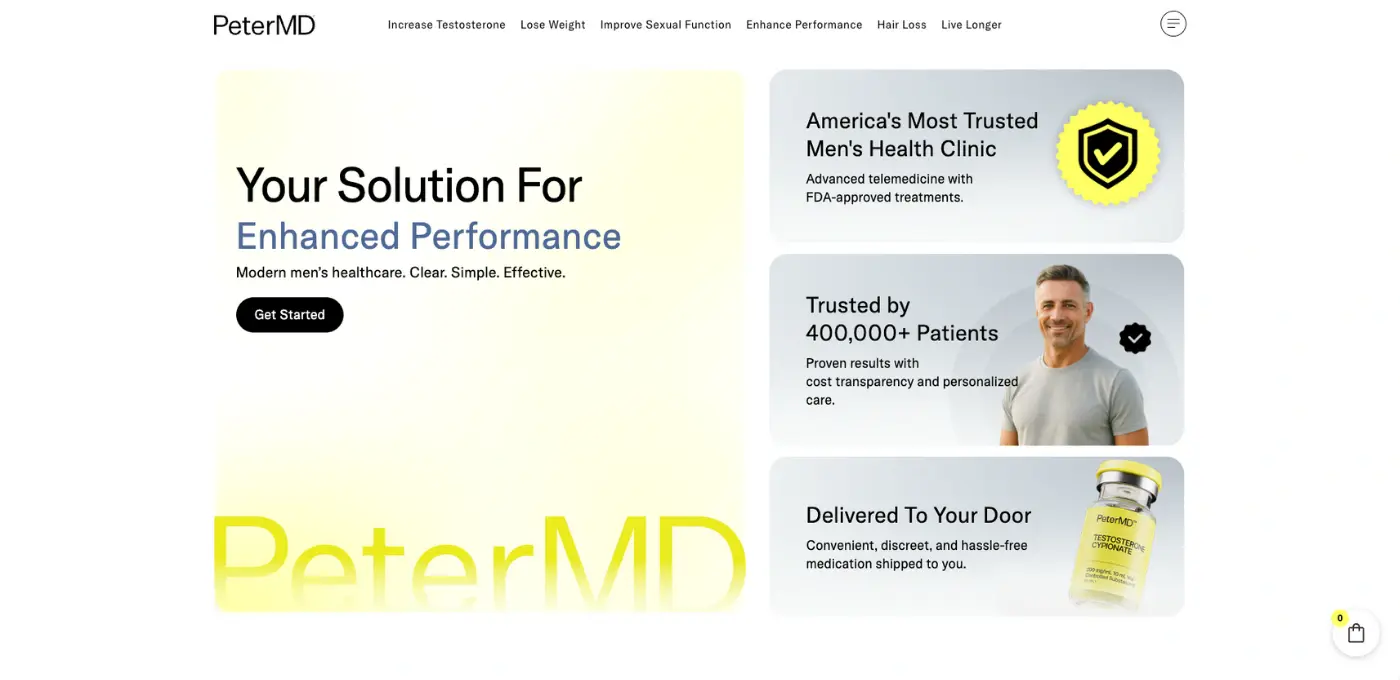
Peter MD is a men's health telehealth platform offering treatment for erectile dysfunction, low testosterone, and weight management through GLP-1 medications. The service operates entirely online with licensed clinicians, accepts HSA and FSA payments, and holds a 9.5 rating (Exceptional) in our ratings. Generic ED medication plans were last recorded at $99/mo in May 2026, and the company advertises a Price-Match Guarantee: if you find TRT at a better price from a competing telehealth service, Peter MD gives you 20% off its own price, not the competitor's.
Sprout Health does one thing: compounded GLP-1 weight loss treatment. Its listing carries compounded semaglutide from $199/mo, verified September 17, 2026, shipped refrigerated from a US pharmacy, and it holds a 9.0 rating (Excellent) in our rankings. Compounded medications are not FDA-approved and have not been reviewed by the FDA for safety, effectiveness or quality. We can't verify Sprout's founding date or operating history from our data, so we won't rank it on track record.
The two overlap on exactly one product. Peter MD runs ED, testosterone and weight loss; Sprout Health runs weight loss and nothing else. If you want ED medication or testosterone therapy, Sprout is not in that market and the comparison ends there. If you want a GLP-1, both are live in our weight loss rankings and the difference comes down to price, formulary and where each one operates.
Pricing and Payment Options
Peter MD offers sildenafil and tadalafil, with ED plans last recorded at $99/mo in May 2026, and testosterone therapy and GLP-1 weight loss programs priced separately based on dosing and shipment frequency; Peter MD is active in our weight loss provider rankings at $209/mo, a price last verified in September 2026 and held flat at any dose. The platform accepts HSA and FSA cards, which can reduce out-of-pocket costs for eligible medical expenses as defined by the
IRS Publication 502. The Price-Match Guarantee is worth reading closely: Peter MD does not match a lower price, it takes 20% off its own price when you find TRT cheaper elsewhere.
Sprout Health publishes a starting price per medication rather than one program rate: compounded semaglutide from $149/mo and compounded tirzepatide from $199/mo, verified September 17, 2026. Both are starting prices, and Sprout does not publish what a higher dose costs, so the figure you are quoted after your evaluation is the one that matters. Against Peter MD's $209/mo weight loss rate, last verified September 2026, Sprout's semaglutide entry is $60 lower and its tirzepatide entry $10 lower. We have no sourced information on whether Sprout accepts HSA or FSA cards, so ask Sprout directly and confirm with your plan administrator before you count on it.
On entry prices Sprout opens lower on both molecules: $149 for semaglutide and $199 for tirzepatide against Peter MD's $209. The tirzepatide gap of $10/month is small enough that coverage, formulary and what each one folds into the price will decide it before the headline rate does, and because Sprout says nothing about higher-dose pricing, neither gap is guaranteed to hold once you titrate up. Peter MD's Price-Match Guarantee gives you 20% off Peter MD's own price if you find TRT cheaper elsewhere, so it does not close a gap on weight loss pricing by itself.
Treatment Options and Medications
Peter MD's catalog covers FDA-approved generic medications for erectile dysfunction including sildenafil and tadalafil, both of which have well-established safety profiles documented by the
FDA's drug approval records. Testosterone replacement therapy options include injectable testosterone cypionate and other formulations prescribed after lab confirmation of low levels. The weight loss program uses GLP-1 receptor agonists, a drug class that has shown meaningful weight reduction in clinical trials.
Sprout Health prescribes compounded semaglutide and tirzepatide, the two GLP-1 molecules, shipped refrigerated from a US pharmacy. Compounded versions are made by a compounding pharmacy rather than the original manufacturer, which means they are not FDA-approved and have not been reviewed by the FDA for safety, effectiveness or quality. Sprout does not name the pharmacy that compounds them, so we can't tell you anything about its sourcing.
Sprout Health's formulary stops at those two GLP-1s. It does not carry ED medication, testosterone therapy, or the branded injectables, so if you want any of those, Peter MD is the platform of the two that has them. On weight loss the medication class is the same on both sides, which is what makes the $10/month gap the thing actually worth weighing.
Clinical Process and Support
Peter MD's intake involves an online medical questionnaire reviewed by a licensed clinician, with lab work required before starting testosterone therapy or certain other treatments. Follow-up messaging is handled through the platform, and prescriptions ship directly to your address from partner pharmacies. The American Urological Association recommends confirming low testosterone with two morning blood draws before initiating therapy, which aligns with
AUA clinical guidelines.
Sprout Health runs a standard telehealth intake: an online health history reviewed by a licensed clinician, then prescription and refrigerated shipping if you are approved. We don't hold sourced detail on its lab requirements, follow-up cadence or messaging support, so ask about those during intake rather than assuming they match Peter MD's.
Peter MD's strength is breadth and turnaround: several men's health categories on one account, with lab work where the treatment requires it. Sprout's strength is narrowness: one category, two published starting prices, one decision. If you want weight loss handled next to ED or testosterone on the same account, that is Peter MD. If the GLP-1 is all you want, Sprout is built for exactly that.
Who Each Brand Is Best For
Peter MD makes the most sense if you're a man dealing with erectile dysfunction symptoms, suspected low testosterone, or wanting structured support for weight loss with GLP-1 medications. The pricing is among the lower end of telehealth options, and the HSA/FSA acceptance adds real value if you're cost-conscious; the Price-Match Guarantee is a 20% discount on Peter MD's own price when you find TRT cheaper elsewhere, not a match. Erectile dysfunction affects roughly 30 million men in the United States according to
NIDDK statistics, so the demand for accessible treatment is substantial.
Sprout Health is the better fit if weight loss is the only thing you need handled and you would rather see the entry number upfront: $149/mo for compounded semaglutide or $199/mo for compounded tirzepatide, verified September 17, 2026, with the caveat that Sprout does not publish what a higher dose costs, so ask. It also matters if Peter MD does not operate in your state, which is worth checking before you compare anything else, since Peter MD's coverage is narrower than Sprout's.
Neither service fully replaces in-person specialty care for complex cases. If you have severe hypogonadism with complications, Peter MD's telehealth model may need to be supplemented with an endocrinologist. On the weight loss side, a compounded GLP-1 from Sprout is not an FDA-approved product, so if you have other conditions being managed, raise it with the physician who manages them before you start.
Final Head-to-Head Comparison
These two services solve different problems for different audiences. Peter MD is built for the man who wants a quick, affordable path to ED medication, testosterone therapy, or weight loss support, with ED plan pricing last recorded at $99/mo in May 2026. Sprout Health is built for one thing, compounded GLP-1 weight loss, starting at $149/mo for semaglutide and $199/mo for tirzepatide, verified September 17, 2026.
On breadth Peter MD wins outright: ED medication, testosterone therapy and weight loss on one account, where Sprout carries only the GLP-1. On weight loss specifically the two are close, with Sprout entering $60/month under Peter MD on semaglutide and $10/month under it on tirzepatide, against Peter MD's $209, and Peter MD holding the higher rating at 9.5 (Exceptional) against Sprout's 9.0 (Excellent). Neither gap is wide enough to decide it on its own, especially since Sprout's figures are opening rates.
If you want ED medication or testosterone, Peter MD is the only one of the two that has them. If you want a compounded GLP-1 at the lower entry rate of the pair, that is Sprout, which opens at $149 for semaglutide and $199 for tirzepatide against Peter MD's $209 - just confirm your quoted rate at your dose before you decide on price alone. Nothing stops you using both if your needs span both categories, though you should give each clinical team the full list of what you take.
Final Verdict: Peter MD vs Sprout Health
Peter MD and Sprout Health overlap on weight loss and diverge everywhere else, so the right choice depends on how much you want handled in one place. Choose Peter MD for men's health treatment covering ED, testosterone and weight loss on one account at $209/mo for the weight loss line, last verified September 2026. Choose Sprout Health if weight loss is the only thing you need and you want the lower entry rate: compounded semaglutide from $149/mo or compounded tirzepatide from $199/mo, verified September 17, 2026, with higher-dose pricing unpublished.
Frequently Asked Questions
Can I use Peter MD if I'm trying to have a baby?
Generally no, at least not for testosterone therapy. Standard TRT can significantly reduce sperm production and is typically avoided when conception is the goal. ED medications like sildenafil and tadalafil from Peter MD do not impair fertility and can be used while trying to conceive, but discuss your situation with the prescribing clinician.
Does Sprout Health treat erectile dysfunction or low testosterone?
No. Sprout Health's listing carries compounded semaglutide and tirzepatide for weight loss and nothing else, so for ED or low testosterone you want Peter MD or another men's health platform.
Are Sprout Health's medications FDA-approved?
No. Sprout Health dispenses compounded semaglutide and tirzepatide, made by a compounding pharmacy rather than the original manufacturer. Compounded medications are not FDA-approved and have not been reviewed by the FDA for safety, effectiveness or quality. The underlying molecules are the same ones in approved GLP-1 products, but these compounded versions have not been through that review, and Sprout does not name the pharmacy that makes them.
Which service accepts HSA and FSA payments?
Peter MD explicitly accepts HSA and FSA cards for qualifying medical expenses. We have no sourced information on whether Sprout Health accepts HSA or FSA cards, so ask Sprout directly and confirm with your plan administrator. IRS rules generally allow prescription medications and clinical consultations as eligible expenses.
How long does it take to see results from either platform?
Peter MD's ED medications work within 30 minutes to a few hours after dosing. Testosterone therapy typically shows symptom changes over 3 to 6 months. Sprout Health's GLP-1 program follows the usual titration schedule, where the dose steps up over the first months, so changes build gradually rather than arriving in the first few weeks. Individual results vary.
Do I need lab work before starting either service?
Yes for most treatments. Peter MD requires lab confirmation before testosterone therapy and may request labs for GLP-1 programs. We don't hold sourced detail on Sprout Health's lab requirements, so ask during intake what it needs before it will prescribe. ED medications through Peter MD generally require only a medical questionnaire rather than full lab work.
Editorial Note: Researched and edited by our editorial team. AI tools assist with initial research and drafting; all content is fact-checked and edited by humans before publication. Learn more about our editorial standards