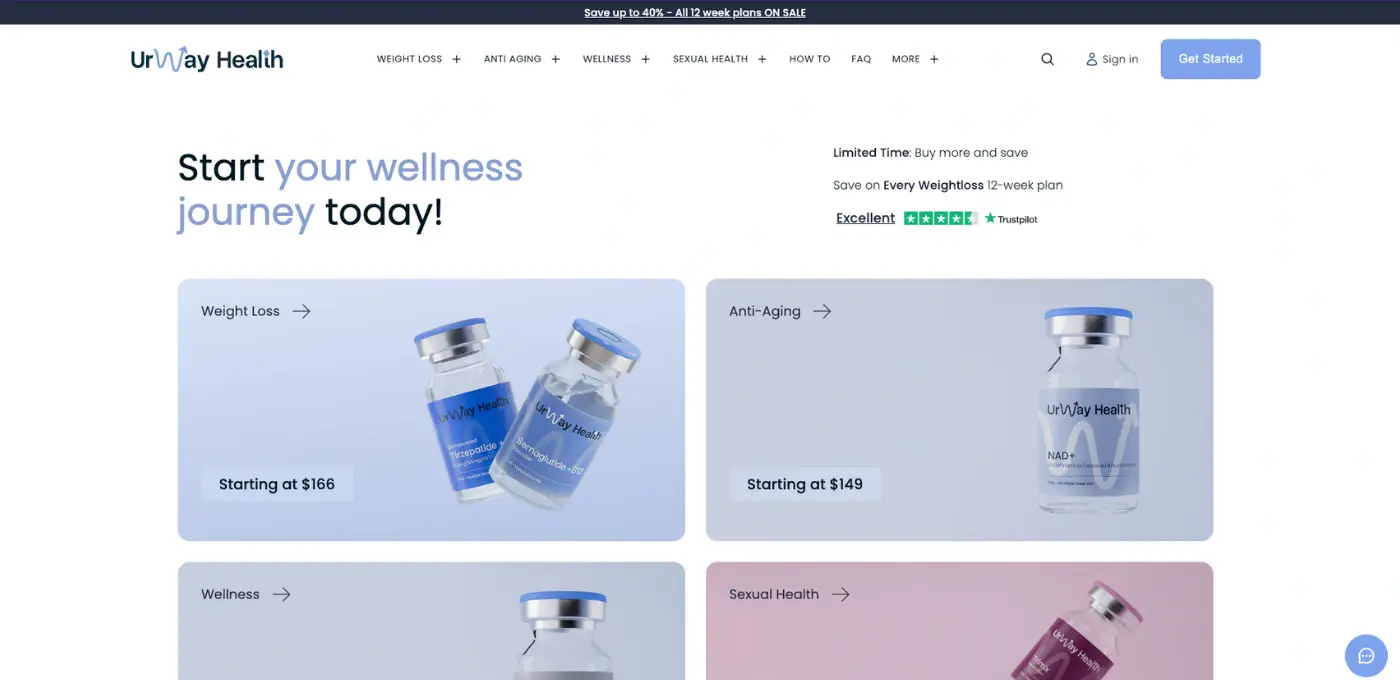
Sprout and UrWay Health represent different budget spectrum approaches - value-tier adequate quality versus ultra-budget extreme cost minimization. Sprout offers both semaglutide and tirzepatide, starting at $149/month for compounded semaglutide and $199/month for compounded tirzepatide, verified September 17, 2026, with basic clinical support, while UrWay Health provides bare-minimum semaglutide access at $49-99/month with minimal services and <2 years of history. That puts Sprout's entry roughly $50-150/month above UrWay depending on which tiers you line up, and this comparison looks at what the gap buys you: medication choice, clinical support you can actually reach, and a service still there in month twelve.
Platform Overview
Sprout is a weight loss telehealth platform built around compounded GLP-1 access without premium service layers. We can't verify its founding date, operating history or funding from our data, so we won't rank it on track record. What our listing shows is compounded semaglutide from $149/mo and compounded tirzepatide from $199/mo, verified September 17, 2026, with basic clinical support but without lifestyle programming.
The platform offers asynchronous consultations with nurse practitioners or physicians, compounded GLP-1 medications (semaglutide and tirzepatide options), and basic ongoing support focused on medication management. Sprout starts compounded semaglutide at $149/mo and compounded tirzepatide at $199/mo, verified September 17, 2026, which sits above the cheapest cash-pay options and below the coaching-heavy programs.
UrWay Health launched in 2023 as an ultra-budget weight loss and premature ejaculation telehealth startup focused on compounded medication access at extremely competitive pricing. With less than 2 years of history, minimal public funding information, and singular focus on cost-optimized treatment access, UrWay Health positions itself among the most affordable GLP-1 providers in the telehealth market at $49-99/month for compounded semaglutide.
The platform offers basic asynchronous consultations with nurse practitioners or physicians, direct-to-consumer shipping of compounded medications, and minimal ongoing support beyond medication refills. UrWay Health serves patients across multiple states with emphasis on transactional efficiency and extreme cost minimization rather than service quality or infrastructure.
Pricing and Cost Structure
Sprout Starting Prices: Sprout lists compounded semaglutide from $149/mo and compounded tirzepatide from $199/mo, verified September 17, 2026, which sits above ultra-budget startups ($49-99/month) and below the coaching-heavy programs ($200-400+/month). Each rate covers the medication at its starting dose, and Sprout does not publish what a higher dose costs, so treat both as floors rather than as a yearly total.
The pricing enables Sprout to maintain adequate clinical infrastructure, reasonable customer support, basic provider oversight, and quality compounded medications while remaining affordable. This middle-tier positioning targets patients seeking affordable access without accepting rock-bottom quality compromises that ultra-budget platforms require.
UrWay Health Ultra-Budget Pricing: UrWay Health charges $49-99/month for compounded semaglutide access - among the absolute lowest GLP-1 pricing in telehealth market. This rock-bottom pricing reflects minimal overhead, basic consultation models, no lifestyle programming, and focus on transactional efficiency at expense of service quality. Annual costs range $588-1,188 for compounded semaglutide.
That runs $50-150/month below where Sprout starts, depending on which UrWay tier and which Sprout molecule you compare. However, these cost savings come with tradeoffs: minimal clinical support infrastructure, no tirzepatide access, extreme uncertainty (<2 years history), substantial business failure risk, and quality concerns given insufficient pricing to support strong operations. The rock-bottom pricing raises questions about long-term sustainability and quality maintenance.
Medication Options
Sprout Both GLP-1 Options: Sprout offers compounded semaglutide and tirzepatide at value pricing, providing both primary GLP-1 options. This medication choice enables patients who benefit from newer tirzepatide formulation to access it while maintaining value pricing. The dual-medication availability shows operational capability to support multiple formulations.
The tirzepatide access proves particularly valuable given evidence suggesting superior weight loss outcomes compared to semaglutide in some patients. Having both options available enables treatment optimization based on individual response and clinical needs rather than being limited to single medication type.
UrWay Health Semaglutide Only: UrWay Health offers exclusively compounded semaglutide with no tirzepatide access, providing no medication diversity. The single-medication focus optimizes costs but eliminates treatment optimization options and limits clinical flexibility.
Patients cannot access tirzepatide if semaglutide proves inadequate, transition between formulations based on side effect profiles, or optimize treatment with medication choice. The medication limitation reflects cost-minimization priority over clinical optimization and treatment flexibility.
Platform Maturity and Business Sustainability
Sprout's Track Record Is Not Something We Can Verify: We can't confirm Sprout's founding date or how long it has been operating, so we won't claim it has outlasted anyone. What we can confirm is where its pricing starts: compounded semaglutide from $149/mo and compounded tirzepatide from $199/mo as of September 17, 2026, which leaves more margin for quality maintenance and infrastructure than a $49-99/mo rate does.
Weight loss treatment often runs 12 to 24 months or longer, so how long a platform has been shipping matters to you. We can't answer that for Sprout from our data, so ask the company directly before you plan a multi-year course around it.
UrWay Health Maximum Uncertainty: With less than 2 years of history since 2023 launch, UrWay Health represents unproven business model sustainability and extreme risk. The ultra-low pricing ($49-99/month) raises serious questions about long-term financial viability and quality maintenance under extreme cost pressure.
Numerous ultra-budget telehealth startups with similar pricing have failed within first 2-3 years due to regulatory compliance costs, inability to scale efficiently, or unsustainable pricing models.
FDA's increased scrutiny of compounded GLP-1s creates regulatory environment where maturity and compliance infrastructure matter critically. Patients choosing UrWay Health accept maximum risk of service disruption, quality deterioration, or complete business failure mid-treatment.
Clinical Support and Service Quality
Sprout Basic But Adequate Clinical Support: Sprout offers standard provider messaging for medication adjustments and side effect reporting, providing basic but adequate clinical support for straightforward GLP-1 management. The platform maintains reasonable response times, basic safety monitoring, and adequate provider oversight for uncomplicated cases.
While not offering full lifestyle programming clinical coaching, Sprout provides sufficient support for medication management, dosage escalation, and basic side effect guidance. For patients with straightforward weight loss progression, this basic support level proves adequate while maintaining value pricing, according to
GoodRx medication pricing data.
UrWay Health Minimal Clinical Support: UrWay Health offers minimal provider messaging for medication refills and emergencies, but provides extremely limited proactive support, clinical guidance, or ongoing care. The platform's ultra-low pricing reflects minimal clinical support infrastructure - providers focused solely on prescription authorization and basic safety monitoring.
Patients experiencing side effects, needing dosage adjustments, or managing complications must navigate challenges with minimal provider engagement. The extreme cost minimization limits clinical infrastructure to bare minimum required for regulatory compliance. For straightforward cases without complications, this minimal support may suffice. For any clinical challenges or guidance needs, the support limitations create serious gaps.
Quality and Sustainability Concerns
Sprout Quality Standards: Sprout's starting rates, $149/mo for compounded semaglutide and $199/mo for compounded tirzepatide, verified September 17, 2026, leave more room for quality standards than a rock-bottom rate does. The pricing provides margin for reasonable compounded medication quality, basic clinical oversight, customer support infrastructure, and regulatory compliance systems. While not premium quality, the service standards prove sufficient for straightforward weight loss treatment.
The pricing model suggests sustainable operations supporting basic quality maintenance. Sprout positions as affordable option maintaining service quality rather than extreme budget platform sacrificing quality for lowest pricing. For value-focused patients wanting reasonable quality assurance, Sprout delivers adequate standards.
UrWay Health Quality Sustainability Questions: UrWay Health's ultra-low pricing ($49-99/month) raises fundamental questions about quality sustainability. The rock-bottom pricing provides minimal margin for quality oversight, strong clinical infrastructure, regulatory compliance. Maintaining adequate quality standards typically requires costs exceeding UrWay Health's pricing.
The extreme cost minimization creates risks: medication quality concerns under cost pressure, inadequate clinical oversight infrastructure, minimal customer support capabilities, and questionable regulatory compliance strongness. While meeting basic current requirements, the pricing model raises concerns about sustained quality maintenance long-term and ability to navigate increased regulatory scrutiny. Patients accept quality risks alongside business failure risk when choosing extreme budget option, according to
FDA GLP-1 safety warnings.
How We Compared UrWay Health vs Sprout Health
This comparison analyzes Sprout and UrWay Health based on pricing models, medication options, maturity, clinical support, and quality sustainability.
Pricing Analysis:
- Sprout: compounded semaglutide from $149/mo and compounded tirzepatide from $199/mo, verified September 17, 2026, with both GLP-1 options; higher-dose pricing is not published
- UrWay Health: $49-99/month ($588-1,188/year) ultra-budget semaglutide only
- Cost difference: UrWay Health lists roughly $50-150/month below where Sprout starts, against substantial quality and service risks
Service Differentiation:
- Sprout: Value-tier positioning with adequate quality and both medication options
- UrWay Health: Ultra-budget extreme cost minimization with minimal services
- Quality balance vs rock-bottom pricing positioning
Risk Considerations:
- Maturity: not verifiable from our data for Sprout; <2 years and maximum risk for UrWay Health
- Quality sustainability: Adequate pricing margin vs insufficient pricing for quality maintenance
- Business viability: Reasonable pricing model vs extreme budget model with high failure risk
Final Verdict: UrWay Health vs Sprout Health
Choose Sprout if: You want reasonable balance between affordability and adequate service quality, need both semaglutide and tirzepatide medication options for treatment optimization, value basic but adequate clinical support, seek lower risk for multi-year treatment commitment, want the margin that a $149/mo semaglutide start and a $199/mo tirzepatide start leave for oversight (verified September 17, 2026), prioritize service sustainability over maximum cost savings, or desire a value-tier option maintaining adequate standards rather than an extreme budget one compromising quality.
Choose UrWay Health if: You face severe financial constraints making every dollar critical, need absolute minimum GLP-1 pricing ($49-99/month) to afford any treatment, have straightforward health with uncomplicated weight loss response, can manage completely independently with minimal clinical support, don't need tirzepatide access or medication flexibility, accept extreme uncertainty and substantial business failure risk, have high risk tolerance for quality sustainability concerns, and prioritize the lowest possible monthly cost over service quality and reliability.
Bottom line: Sprout and UrWay Health represent budget spectrum options - value-tier adequate quality versus ultra-budget extreme cost minimization. Sprout delivers both GLP-1 medication options and adequate clinical support from $149/mo for compounded semaglutide and $199/mo for compounded tirzepatide, verified September 17, 2026. UrWay Health lists roughly $50-150/month less but creates substantial quality sustainability questions, extreme risk, and minimal service infrastructure at $49-99/month. If you are value-focused, Sprout provides the better overall proposition by maintaining adequate quality standards and medication options at reasonable pricing. If you are severely constrained financially and accept substantial compromises in service quality, UrWay Health gets you basic GLP-1 access you might not otherwise afford. The difference buys medication choice and support you can reach, which makes Sprout the more prudent choice if you can afford it.
Editorial Note: Researched and edited by our editorial team. AI tools assist with initial research and drafting; all content is fact-checked and edited by humans before publication. Learn more about our editorial standards