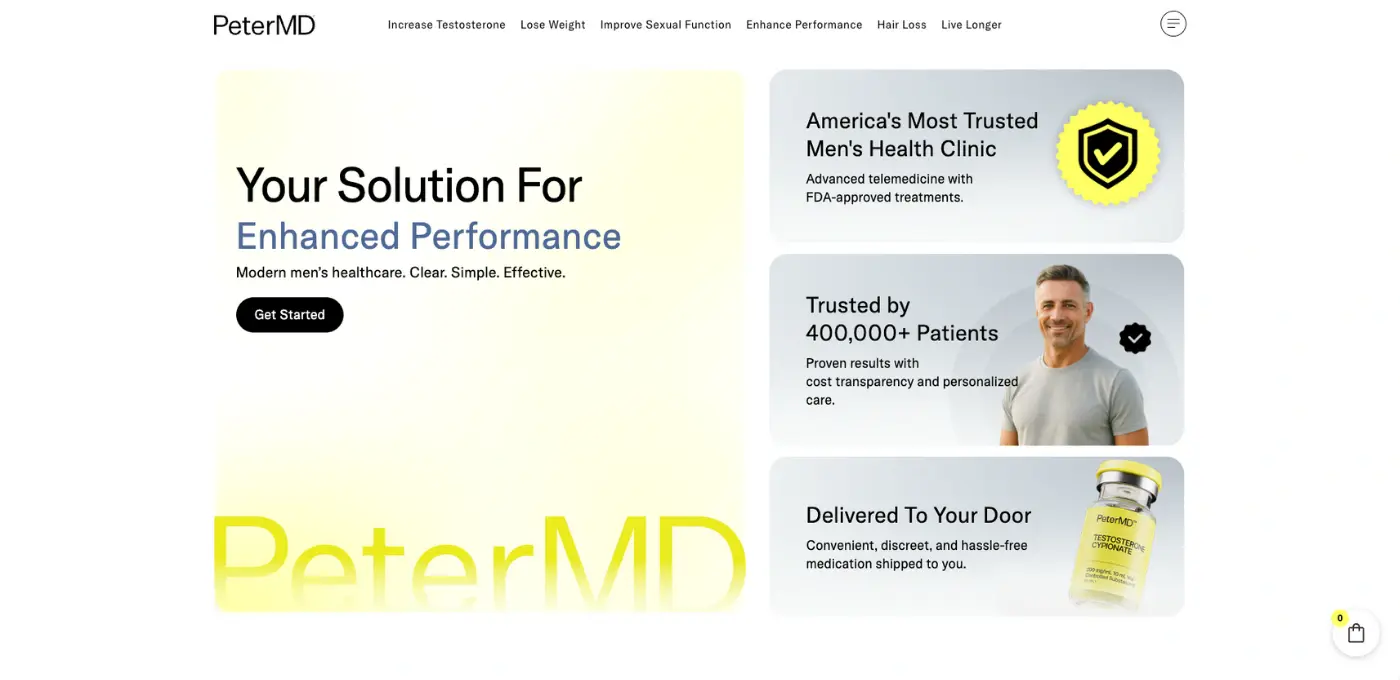
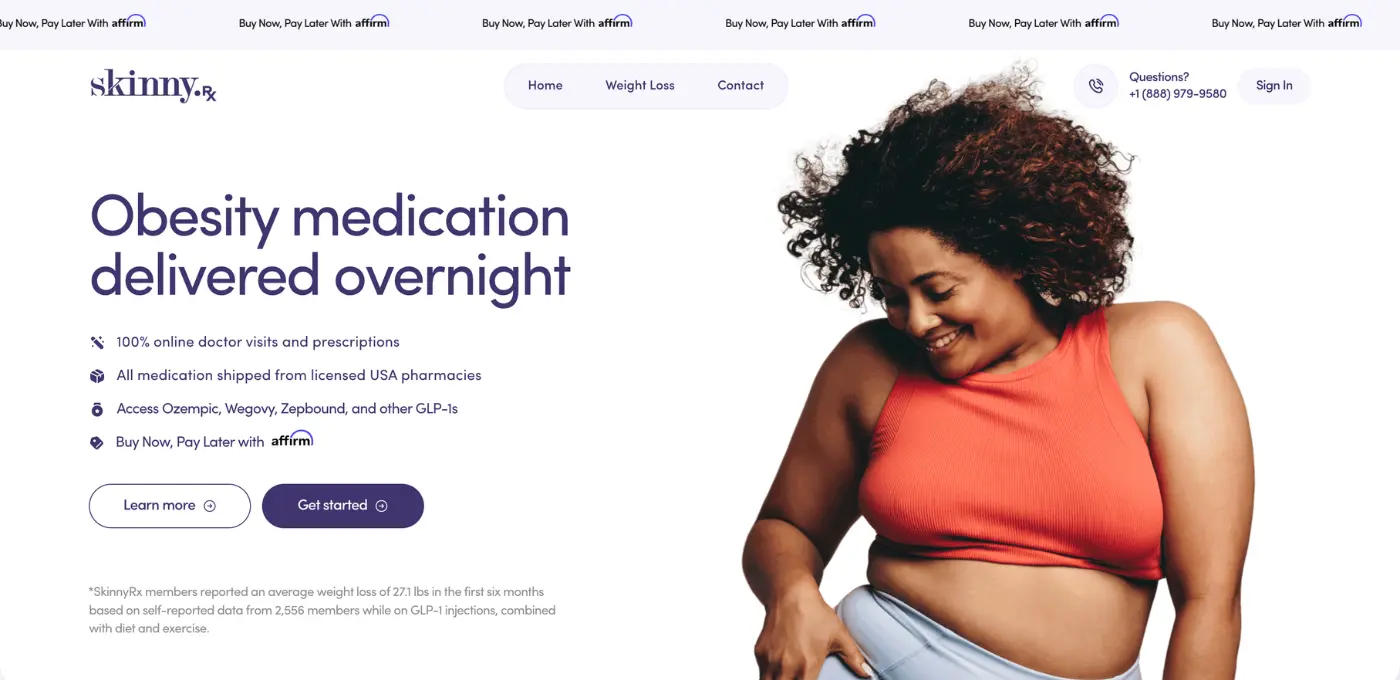
Choosing between Peter MD and Skinny.Rx depends on what you need treated. Peter MD covers men's health broadly (ED, testosterone, weight loss), while Skinny.Rx focuses only on GLP-1 weight loss medications for any adult. Here's how the two telehealth services compare on price, treatments, and support.
Peter MD vs Skinny.Rx: Brand Overview
Peter MD is a men's health telehealth platform that treats erectile dysfunction, low testosterone, and weight loss through GLP-1 medications. The service holds a 9.5 rating (Exceptional) in our ratings and accepts HSA and FSA payments, making it one of the more flexible options for covering treatment costs. Peter MD also advertises a Price-Match Guarantee, which gives you 20% off its own price if you find TRT cheaper elsewhere rather than matching the lower price.
Skinny.Rx takes a narrower approach, focusing only on GLP-1 weight loss medications like compounded semaglutide and tirzepatide. The platform serves all adults nationwide and carries a 9.0 rating, with plans starting at $149 per month. By concentrating on a single category, Skinny.Rx aims to make GLP-1 access faster and more affordable than broader telehealth services.
The core difference comes down to scope. Peter MD treats several men's health conditions under one account, while Skinny.Rx serves anyone seeking weight loss support regardless of gender. Telehealth use has grown significantly since 2020, with the CDC reporting that 37% of adults used telemedicine in a recent survey year, according to
CDC data on telemedicine use.
Pricing Comparison
Peter MD prices ED medications starting at $1.50 per dose for generic sildenafil or tadalafil, which is competitive with the lowest-cost telehealth ED options available. Testosterone therapy and GLP-1 weight loss pricing varies based on dosage and protocol, and Peter MD's Price-Match Guarantee means 20% off its own price if you find TRT cheaper elsewhere, not a match of that lower price. HSA and FSA cards are accepted, which can reduce out-of-pocket costs depending on your tax bracket.
Skinny.Rx starts at $149 per month for compounded GLP-1 medications, which typically includes the medication, provider consultation, and ongoing support. This pricing sits in the mid-range for compounded semaglutide and tirzepatide telehealth services, where monthly costs commonly run from $150 to $400 depending on dose escalation. Branded GLP-1s like Wegovy and Zepbound list at over $1,000 per month before insurance, so compounded alternatives can offer meaningful savings.
If you're paying with HSA or FSA funds, Peter MD's acceptance of these accounts is worth noting since not every telehealth service supports them. According to
IRS Publication 502, prescription medications and weight loss treatments tied to a specific medical condition can qualify as eligible medical expenses. Always check with your plan administrator before assuming a service will reimburse.
Treatment Options and Medications
Peter MD offers a broader medication menu, including sildenafil and tadalafil for ED, testosterone replacement therapy formulations, and GLP-1 receptor agonists for weight loss. Sildenafil and tadalafil are FDA-approved generics with decades of safety data behind them, and tadalafil's longer half-life of about 17.5 hours allows for more flexible dosing compared to sildenafil's 4-hour window. The FDA originally approved sildenafil in 1998, as documented in FDA approval records.
Skinny.Rx focuses on compounded semaglutide and tirzepatide, which contain the active ingredients found in Ozempic, Wegovy, Mounjaro, and Zepbound. Compounded versions are not FDA-approved and are not reviewed by the FDA for safety, effectiveness, or quality. In the SURMOUNT-1 trial published in the New England Journal of Medicine, participants taking tirzepatide 15mg lost an average of 20.9% of their body weight over 72 weeks, as reported in NEJM clinical trial data. Compounded versions are not FDA-approved but can be legally produced by licensed compounding pharmacies under specific conditions.
Testosterone therapy through Peter MD involves lab testing and ongoing monitoring, since exogenous testosterone affects red blood cell counts, lipid profiles, and fertility. The Endocrine Society recommends confirming low testosterone with two morning blood draws before starting therapy, a guideline that responsible telehealth providers should follow. Skinny.Rx does not offer testosterone or ED treatment, so men seeking those alongside weight loss would need a separate provider.
Clinical Process and Support
Both Peter MD and Skinny.Rx use an asynchronous telehealth model where you complete an intake form, a licensed provider reviews your information, and medication ships from a partner pharmacy if approved. Peter MD's process for testosterone therapy includes lab work, which is required to diagnose hypogonadism according to clinical guidelines from the NIH National Library of Medicine. Without lab confirmation, testosterone prescribing falls outside accepted standards of care.
Skinny.Rx's process is streamlined for GLP-1 access, typically involving a medical questionnaire, photo or video verification, and provider review without requiring labs in many cases. Some weight loss telehealth services do request baseline labs to screen for thyroid issues or pancreatitis risk, so it's worth asking what's included before signing up. Ongoing support usually involves messaging with a care team and dose adjustment guidance over time.
Side effect monitoring matters with both services. ED medications can cause headaches, flushing, and rare visual changes, while GLP-1s commonly cause nausea, vomiting, and constipation, particularly during dose escalation. The FDA has documented these reactions in postmarketing surveillance, with semaglutide labeling noting gastrointestinal events in up to 44% of trial participants per
FDA prescribing information.
Who Each Brand Is Best For
Peter MD makes the most sense if you're a man dealing with multiple health concerns at once, like ED plus weight gain or low energy plus interest in testosterone therapy. Having one provider handle several prescriptions can simplify follow-up and reduce the hassle of managing accounts across multiple telehealth services. The HSA/FSA acceptance also benefits anyone watching costs closely, and the Price-Match Guarantee takes 20% off Peter MD's own price if you find TRT cheaper elsewhere.
Skinny.Rx is better suited if your only goal is weight loss and you want a service focused entirely on GLP-1 medications. The narrow focus often translates to faster intake, more competitive monthly pricing, and a care team that specializes in weight management coaching. Women seeking GLP-1 treatment also need an alternative to Peter MD, since that brand serves men only.
Obesity affects more than 40% of US adults according to CDC obesity statistics, and access to GLP-1 medications has expanded significantly through telehealth. If you don't need ED or testosterone treatment, paying for a men's health platform doesn't add value over a focused weight loss service. The right choice depends on whether you want one-stop care or a specialist.
Final Comparison
Peter MD wins on breadth, offering ED, testosterone, and GLP-1 weight loss under a single men's health account with HSA/FSA support and a Price-Match Guarantee that gives 20% off Peter MD's own price when you find TRT cheaper elsewhere. Peter MD holds a 9.5 rating (Exceptional) in our ratings, and starting prices of $1.50 per dose for ED generics are among the lowest in the category. The trade-off is that Peter MD only serves men.
Skinny.Rx wins on focus and accessibility, serving any adult nationwide with compounded semaglutide and tirzepatide starting at $149 per month. We rate it 9.0, and the focus may translate to better support for GLP-1 specific questions. Compounded GLP-1 access filled gaps during the branded medication shortages tracked by the
FDA Drug Shortages database, which the FDA declared resolved in 2024-2025.
Neither service is universally better, the right pick depends on what you're treating and who you are. A man with ED and weight loss goals gets more value from Peter MD's combined offering. A woman or man whose only need is GLP-1 treatment will likely find Skinny.Rx more efficient and cost-effective.
Final Verdict: Peter MD vs Skinny.Rx
Peter MD is the better choice if you're a man wanting ED, testosterone, or weight loss treatment from a single platform with HSA/FSA support and a Price-Match Guarantee (20% off Peter MD's own price if you find TRT cheaper elsewhere). Skinny.Rx is the stronger pick if you want GLP-1 weight loss specifically, regardless of gender, with transparent pricing starting at $149 per month. Match the service to your actual needs rather than picking based on brand recognition alone.
Frequently Asked Questions
Can women use Peter MD?
No, Peter MD is a men's health platform and only treats men. If you're a woman seeking GLP-1 weight loss medication, Skinny.Rx is open to all adults nationwide regardless of gender.
Is compounded semaglutide from Skinny.Rx FDA-approved?
Compounded semaglutide is not FDA-approved as a finished product, but it can be legally prepared by licensed compounding pharmacies. The FDA approves the active ingredient, while compounded versions fall under separate compounding rules. Branded supply is no longer the trigger it was in 2023 and 2024, and what a compounded prescription has to carry now is a prescriber's documented reason for compounding it for you.
Does Peter MD require blood work for testosterone therapy?
Yes, testosterone therapy through Peter MD requires lab testing to confirm low testosterone before prescribing. The Endocrine Society recommends two morning blood draws to diagnose hypogonadism, and responsible telehealth providers follow this standard.
Which service is cheaper for weight loss?
Skinny.Rx publishes a starting price of $149 per month for compounded GLP-1 treatment. Peter MD offers GLP-1 weight loss but pricing varies, and its Price-Match Guarantee gives you 20% off Peter MD's own price if you find TRT cheaper elsewhere, which is not the same as matching a lower weight loss price.
Can I use HSA or FSA funds for either service?
Peter MD accepts HSA and FSA payments directly. Skinny.Rx eligibility depends on your plan administrator and whether the prescription qualifies under IRS rules, so check before assuming reimbursement.
Do either of these services offer in-person visits?
No, both Peter MD and Skinny.Rx operate as telehealth-only platforms. Consultations, prescriptions, and follow-ups happen online, with medications shipped to your address from partner pharmacies.
Editorial Note: Researched and edited by our editorial team. AI tools assist with initial research and drafting; all content is fact-checked and edited by humans before publication. Learn more about our editorial standards