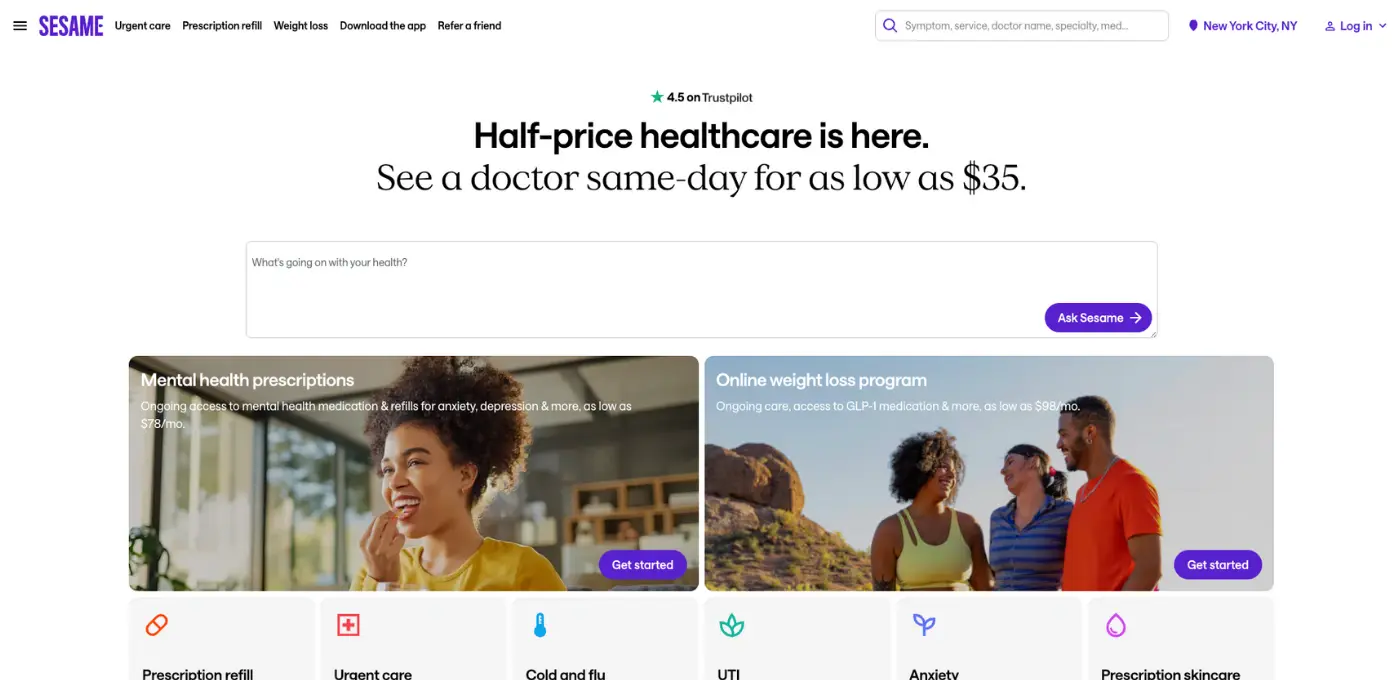
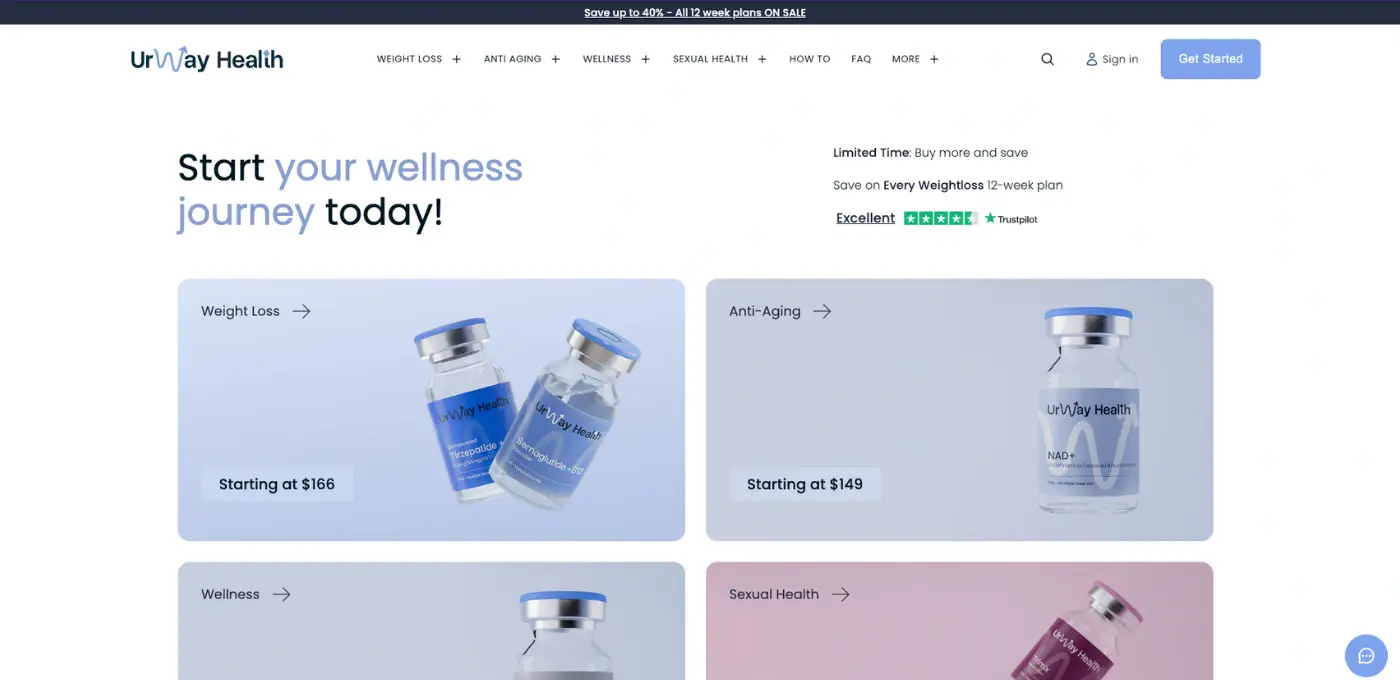
Sesame Care and UrWay Health represent opposite extremes - established full healthcare marketplace versus ultra-budget minimal-service startup with maximum risk. Sesame connects patients with independent providers across weight loss, primary care, mental health, and diverse specialties at marketplace-determined pricing ($149-299/month typical) with 5+ year of track record, while UrWay Health provides bare-minimum compounded semaglutide at $49-99/month with <2 years of history. This comparison analyzes whether UrWay Health's $1,200-2,400/year cost savings justify complete loss of marketplace infrastructure, provider choice, multi-service healthcare integration, and extreme uncertainty, helping patients choose between healthcare marketplace and rock-bottom pricing with maximum compromises.
Platform Overview
Sesame Care launched in 2019 as a healthcare marketplace platform connecting patients directly with providers for cash-pay services across multiple specialties. With 5+ years of history and focus on transparent cash pricing, Sesame positions as affordable healthcare marketplace serving patients seeking direct provider relationships across primary care, mental health, weight loss, and specialty consultations, according to
GoodRx medication pricing data.
The platform operates as marketplace connecting patients with independent physicians, nurse practitioners, and specialists. For weight loss, Sesame offers GLP-1 services through marketplace providers at $149-299/month typically. The marketplace model enables provider choice, transparent pricing, healthcare coordination, according to
FDA semaglutide safety information.
UrWay Health launched in 2023 as ultra-budget weight loss and premature ejaculation telehealth startup focused on compounded medication access at extremely competitive pricing. With less than 2 years of history and singular focus on cost optimization, UrWay Health positions as among most affordable GLP-1 providers at $49-99/month for compounded semaglutide, according to
FDA compounding regulations.
The platform offers basic asynchronous consultations, direct shipping of compounded medications, and minimal ongoing support beyond refills. UrWay Health serves patients with emphasis on transactional efficiency and extreme cost minimization rather than care or infrastructure.
Service Scope and Healthcare Model
Sesame Care Healthcare Marketplace: Sesame offers services across numerous categories through independent providers: primary care, mental health, urgent care, women's health, weight loss, dermatology, specialty consultations, lab testing, and preventive care. This marketplace breadth enables healthcare coordination through unified platform with transparent pricing.
Patients can build healthcare teams across specialties - coordinating weight loss with primary care, mental health services, lab monitoring, and specialty needs through marketplace provider diversity. The scope facilitates integrated healthcare management impossible with single-category platforms.
UrWay Health Minimal Two-Category Focus: UrWay Health offers exclusively weight loss and premature ejaculation treatments with compounded medications, providing no additional health categories, healthcare marketplace infrastructure, or full-service services. The platform provides basic consultations focused solely on eligibility screening and prescription authorization, according to
FDA compounding regulations.
This narrow focus enables aggressive cost optimization but eliminates healthcare integration completely. Patients needing primary care, mental health services, lab testing, or specialty care must coordinate through entirely separate platforms. The minimal service scope creates maximum care fragmentation for any health needs beyond isolated weight loss.
Pricing and Cost Structure
Sesame Care Marketplace Transparent Pricing: Sesame displays transparent cash pricing set by independent providers, typically $149-299/month for weight loss depending on provider and medication. The marketplace enables price comparison and cost understanding before commitment. Provider competition can drive reasonable pricing while maintaining quality.
Annual costs range $1,788-3,588 depending on provider selection. The marketplace model enables cost-conscious provider selection while accessing healthcare through unified platform.
UrWay Health Ultra-Budget Pricing: UrWay Health charges $49-99/month for compounded semaglutide - among absolute lowest GLP-1 pricing in telehealth market. This rock-bottom pricing reflects minimal overhead, no healthcare marketplace infrastructure, and focus on transactional efficiency. Annual costs range $588-1,188.
This represents $1,200-2,400/year savings compared to Sesame's typical pricing. However, these cost savings come with extreme tradeoffs: no marketplace provider choice, no multi-category healthcare access, minimal clinical support, unproven sustainability (<2 years), maximum business failure risk, and complete loss of healthcare integration benefits.
Platform Maturity and Reliability
Sesame Care Established Marketplace: With 5+ years of history since 2019, Sesame has developed mature marketplace infrastructure, provider network management, and demonstrated business sustainability. The platform maintains relationships with thousands of independent providers and operates full marketplace technology.
Maturity shows in consistent marketplace functionality, established provider vetting, proven payment processing, and track record maintaining platform quality. The marketplace business model creates sustainability through platform fees supporting long-term operations.
UrWay Health Maximum Uncertainty: With less than 2 years of history since 2023, UrWay Health represents unproven business sustainability and extreme risk. The ultra-low pricing ($49-99/month) raises serious questions about long-term financial viability and quality maintenance under extreme cost pressure.
Numerous ultra-budget telehealth startups with similar pricing have failed within first 2-3 years due to regulatory compliance costs, inability to scale efficiently, or unsustainable pricing models.
FDA's increased scrutiny of compounded GLP-1s creates regulatory environment where maturity matters critically. Patients choosing UrWay Health accept maximum risk of service disruption, quality deterioration, or complete business failure mid-treatment.
Provider Access and Quality
Sesame Care Marketplace Provider Diversity: Sesame connects patients with independent licensed providers who maintain professional practices. Patients can view provider profiles, credentials, ratings, and pricing before selection. This marketplace model offers provider choice enabling customization based on expertise, approach, and preferences.
The provider diversity within marketplace creates quality variability - patients must research and select carefully. However, marketplace reviews and ratings help identify quality providers. The ability to select specific providers based on credentials and expertise enables finding comprehensive care matching individual needs.
UrWay Health Minimal Standardized Service: UrWay Health employs staff providers delivering minimal standardized consultations focused on prescription authorization. The platform uses questionnaire-based assessment without video visits or full evaluation. All patients receive same minimal service focused on transactional efficiency.
The ultra-low pricing reflects minimal clinical infrastructure and support. Patients experiencing complications, needing dosage adjustments, or requiring clinical guidance must navigate challenges with minimal provider engagement. The extreme cost minimization limits quality infrastructure to bare regulatory minimum.
Healthcare Integration vs Isolation
Sesame Care Integrated Healthcare Marketplace: Sesame enables healthcare coordination through marketplace connecting diverse provider types. Patients can coordinate weight loss with primary care physicians managing comorbidities, mental health therapists addressing eating behaviors, lab services monitoring metabolic markers, and specialty consultations as needed - all through unified marketplace platform, according to
FSMB telemedicine prescribing policies.
This integrated approach proves valuable for weight loss management requiring coordination across multiple health domains. The marketplace facilitates building healthcare team while maintaining transparent pricing and provider choice.
UrWay Health Full Healthcare Isolation: UrWay Health offers zero healthcare integration or coordination beyond basic weight loss medication. The platform provides no ability to coordinate lab testing, primary care, mental health services, or specialty needs through platform.
Patients must independently coordinate all additional healthcare needs through completely separate providers without integrated oversight. Those needing lab monitoring, comorbidity management, mental health support, or primary care coordination must build separate healthcare relationships creating maximum fragmentation.
How We Compared Sesame Care vs UrWay Health
This comparison analyzes Sesame Care and UrWay Health based on service models, healthcare integration, maturity, and pricing structures. Analysis incorporates risk assessment for ultra-budget startups and practical considerations for long-term treatment sustainability healthcare coordination.
Clinical Evidence:
Pricing Analysis:
- Sesame Care: $149-299/month ($1,788-3,588/year) marketplace with healthcare access
- UrWay Health: $49-99/month ($588-1,188/year) ultra-budget isolated weight loss only
- Cost difference: $1,200-2,400/year savings with UrWay Health but complete loss of marketplace infrastructure and extreme risk
Service Differentiation:
- Sesame Care: Healthcare marketplace with provider diversity and multi-service integration
- UrWay Health: Ultra-budget single-category minimal service with maximum uncertainty
- Marketplace infrastructure vs extreme cost minimization positioning
Final Verdict: Sesame Care vs UrWay Health
Choose Sesame Care if: You need healthcare services beyond isolated weight loss, want marketplace provider choice and transparent pricing, require healthcare coordination across multiple specialties (primary care, mental health, labs, specialty care), seek maturity and proven platform sustainability (5+ years), value healthcare marketplace infrastructure enabling integrated care team building, need flexibility to select providers based on expertise and credentials, want reliable business model supporting long-term treatment, or prioritize healthcare integration and reliability over cost minimization.
Choose UrWay Health if: You face severe financial constraints making every dollar critical for treatment access, need absolute minimum GLP-1 pricing ($49-99/month) to afford any treatment, have straightforward isolated health with uncomplicated weight loss response, can manage completely independently with minimal clinical support, don't need any healthcare integration or multi-service coordination, accept extreme uncertainty and substantial business failure risk (<2 years), have maximum risk tolerance for quality sustainability concerns, require no lab monitoring or comorbidity management, and prioritize maximum cost savings ($1,200-2,400/year) over marketplace infrastructure, healthcare integration, provider choice, and reliability.
Bottom line: Sesame Care and UrWay Health represent opposite extremes - established healthcare marketplace versus ultra-budget minimal-service startup with maximum risk. Sesame delivers healthcare marketplace infrastructure, provider diversity, multi-service integration, transparent pricing competition, and proven 5+ year sustainability enabling end-to-end healthcare coordination. UrWay Health offers substantial cost savings ($1,200-2,400/year) but eliminates all marketplace benefits, healthcare integration, provider choice, and carries extreme risk with minimal service infrastructure. For patients needing healthcare coordination, provider customization, reliability, or multiple health services, Sesame delivers incomparably superior value through marketplace breadth and established infrastructure. For severely financially-constrained patients with straightforward isolated needs accepting substantial and quality risks, UrWay Health enables basic GLP-1 access at lowest cost. The marketplace versus ultra-budget choice depends on whether healthcare infrastructure and reliability justify $1,200-2,400/year premium over bare-minimum medication access with maximum compromises.
Editorial Note: Researched and edited by our editorial team. AI tools assist with initial research and drafting; all content is fact-checked and edited by humans before publication. Learn more about our editorial standards