

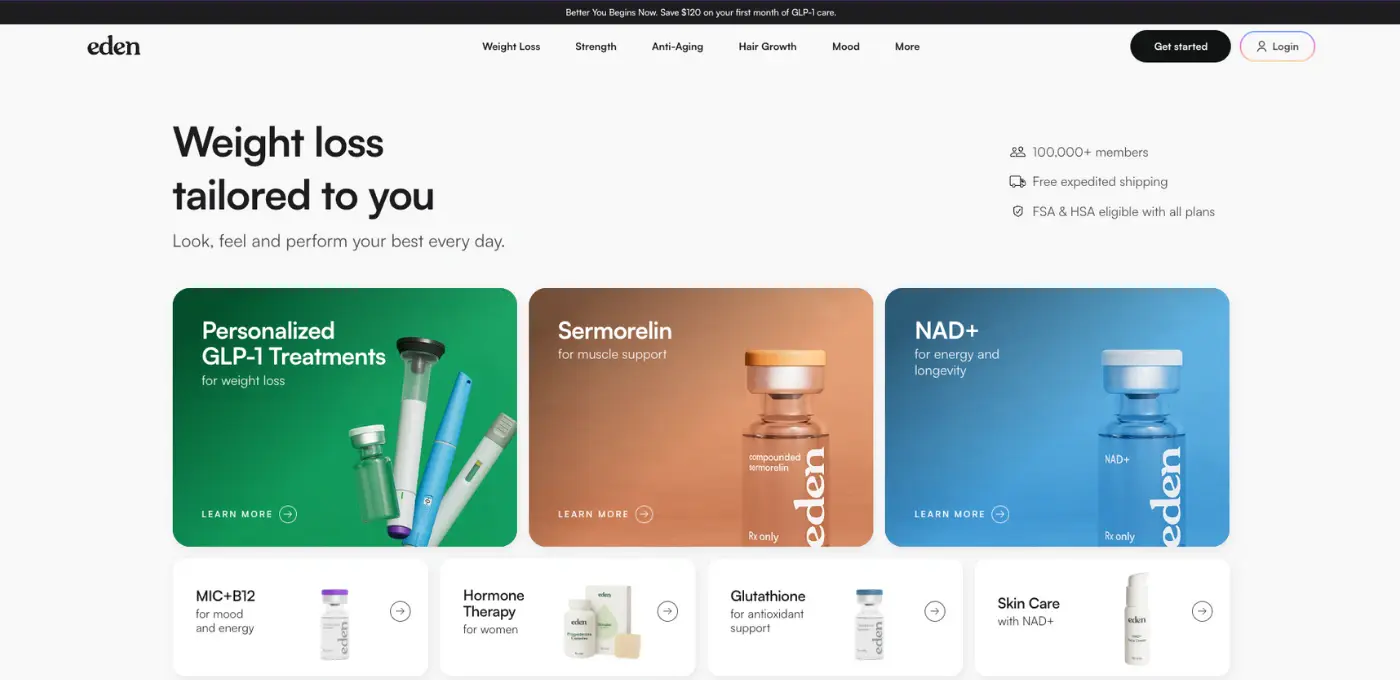
Eden (formerly GetRoman spin-off) offers men's health treatments including ED, hair loss, and weight loss with a focus on affordability and convenience.
Rating9.1/10
Free ConsultationYes
Free ShippingYes
HSA/FSAYes
We earn commissions from the providers listed here. No provider buys a position, a rating, or a listing. The order is set by hand, and we do not claim it is independent of what we earn. Advertising Disclosure


Complete 2026 Comparison for Erectile Dysfunction


Eden (formerly GetRoman spin-off) offers men's health treatments including ED, hair loss, and weight loss with a focus on affordability and convenience.
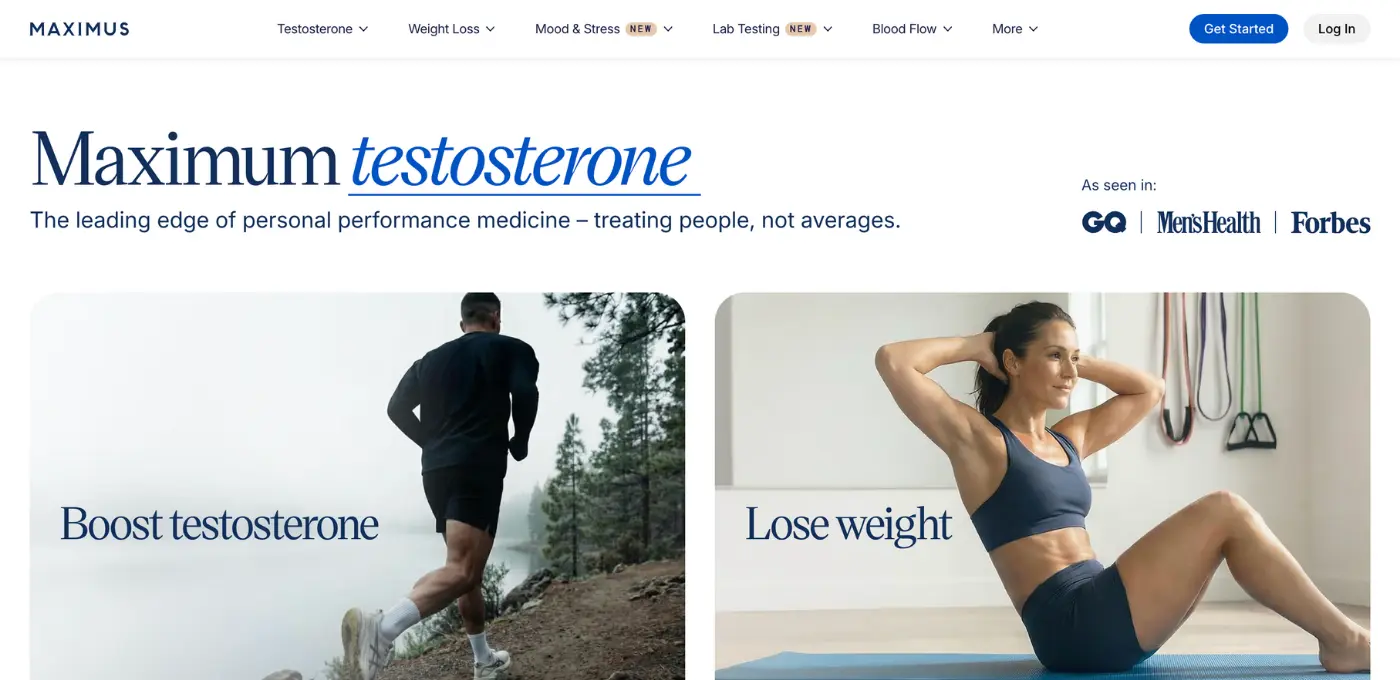
Maximus specializes in testosterone replacement therapy and erectile dysfunction treatment for men, offering injectable TRT, enclomiphene, and ED medications through a streamlined telehealth platform.
| Feature | Eden | Maximus |
|---|---|---|
| Rating | 9.1/10 | 9.2/10 |
| Founded | 2018 | 2021 |
| Free Consultation | Yes | No |
| Free Shipping | Yes | Yes |
| Accepts Insurance | No | No |
| HSA/FSA Accepted | Yes | Yes |
| Mobile App | No | No |
| Consultation Type | Asynchronous | Video, Asynchronous |
| Shipping Time | 3-5 business days | 3-5 business days |
| Treatment | | |
|---|---|---|
| Erectile Dysfunction | N/A | $49/mo$49-$99/mo |
Choose Eden if you:Choose Maximus if you:The better choice depends on your specific needs and priorities. Eden carries a 8.4/10 rating in our provider database and is listed as a fit for budget-conscious men. Maximus carries a 9.7/10 rating in our provider database and is listed as a fit for men with low testosterone symptoms. Those scores are our own editorial ratings, not third-party review averages. Eden was founded in 2018 in San Francisco, CA, while Maximus was founded in 2021 in Austin, TX. Both are US telehealth platforms that connect you with licensed providers, and which one suits you is a question for that provider.
Pricing varies by treatment category. Eden pricing varies. Maximus starts at $49/mo (range: $49-$99/mo). These are the rates last recorded in our provider database, so confirm the current price at checkout before you enroll. Eden lists free consultations. Eden lists free shipping. Maximus lists free shipping. Eden and Maximus list HSA and FSA payment options, though whether a given charge is eligible depends on your plan and on IRS rules for that expense.
Eden does not list health insurance as accepted, and operates on a cash-pay model with published pricing. Maximus does not list insurance as accepted. Eden and Maximus list HSA and FSA payment options; eligibility for any specific charge depends on your plan and IRS rules, so check with your plan administrator first. Coverage and pricing change, so confirm both with the platform and your insurer before you enroll.
Both are established US telehealth platforms. Eden was founded in 2018 and is headquartered in San Francisco, CA. Maximus was founded in 2021 in Austin, TX. Both state that they work with US-licensed providers and licensed pharmacies and that they operate under HIPAA. We do not independently audit provider credentials or pharmacy licensing, so if you want that confirmed, you can look up an individual prescriber through your state medical board and a pharmacy through your state board of pharmacy.
Eden offers asynchronous consultations (free). Maximus provides video and asynchronous consultations. On both, you complete a health questionnaire online that a licensed provider reviews. Video consultations are available if you prefer to speak with a provider face to face. Turnaround times vary by platform, by state, and by how busy the provider network is, and you can message your provider with follow-up questions through the platform.
Eden lists shipping within 3-5 business days with free standard shipping. Maximus lists shipping within 3-5 business days with free standard shipping. Both describe discreet packaging, and medications ship from licensed pharmacies rather than from the platform itself. Actual delivery time depends on your state, the pharmacy, and whether your prescription needs follow-up.
Eden requires a subscription for most treatments and lists cancellation at any time without a fee. Maximus also uses a subscription model and lists no cancellation penalty. Cancellation terms are set by each platform and can change, so read the current terms before you enroll. As a general rule you need to cancel before your next billing date to avoid the following period's charge, and anything already shipped is still yours.
Eden lists Sildenafil, Tadalafil starting at prices that vary. Maximus lists Sildenafil, Tadalafil, Vardenafil starting at $49/mo. Standard sildenafil (generic Viagra) and tadalafil (generic Cialis) tablets are FDA-approved for erectile dysfunction. The differences you can actually compare here are price, dosing schedule, available formats, and regulatory status. Which drug and dose fit you is a decision for a licensed provider, who also needs to rule out interactions, nitrate use above all.
Side effects come from the medication, not from the platform, so this is mostly a question about the drug you end up on rather than about Eden versus Maximus. Reported effects vary by treatment: ED medications may cause headache, flushing, or nasal congestion; finasteride carries labeled sexual side effects that some men report persisting after they stop; GLP-1 medications commonly cause nausea, vomiting, and other gastrointestinal effects, especially when the dose goes up; SSRIs may cause drowsiness, nausea, or changes in appetite and sexual function. This is not the full list for any of them. Both platforms have licensed providers review your medical history and screen for contraindications, and you should read the medication guide and raise anything you notice with your provider.
Choose Eden if you prioritize: budget-conscious men, those seeking simple ed treatment. Choose Maximus if you prioritize: men with low testosterone symptoms, those seeking multiple trt delivery options. Eden stands out for: Competitive pricing. Maximus is known for: Multiple TRT delivery methods (injection, oral, gel). Both are established telehealth platforms, so your choice mostly comes down to price, which treatments each one carries, and how you prefer to handle visits and refills.
The process is similar on both. For Eden: visit their website, select your treatment category, and complete a health questionnaire that a licensed provider reviews. For Maximus: follow the same kind of flow on their platform. Both ask for your medical history, current medications, and answers to health screening questions, and being straight with those answers is what lets the provider catch an interaction. If you are approved, the prescription goes to a licensed pharmacy and ships to you (often with free shipping). How long the whole thing takes depends on the platform, your state, and the pharmacy.
Eden carries a 8.4/10 rating in our provider database, and Maximus carries a 9.7/10 rating in our provider database. Those are ManyTreatments editorial scores on a 10-point scale, not averages pulled from third-party review sites, and you can read how we build them on our how-we-rate page. What we weigh: Eden scores well on competitive ed pricing, with smaller company with fewer reviews as the trade-off. For Maximus it is multiple trt options (injectable, oral, gel), against no insurance accepted. If you want customer sentiment as well, check current listings on the review platforms directly, since those move.
Medical Disclaimer: The information on this page is for educational purposes only and is not medical advice. Always consult with a licensed healthcare provider before starting any treatment. Read our full medical disclaimer.
Regulatory noticeRegulatory note (verified August 22, 2026): Eden Health International Inc. was sent FDA warning letter MARCS-CMS 728279 on June 8, 2026, following an agency review of tryeden.com in March 2026. The letter lists two findings. The first is the "Eden" name on pictured labels for compounded semaglutide and tirzepatide, which the FDA said represents Eden as the compounder when it is not. The second is the site’s description of its sourcing as "FDA-licensed 503(a) outsourcing facilities," a designation the agency says does not exist, because the FD&C Act creates no FDA approval or license for pharmacies or outsourcing facilities. Both were cited as misbranding under sections 502(a) and 502(bb). FDA has posted no close-out letter, so the matter reads as open. Read the FDA letter
Regulatory noticeRegulatory note (verified August 22, 2026): A May 2026 review of maximustribe.com led the FDA to issue Maximus Health, Inc. warning letter MARCS-CMS 730095 on June 8, 2026. The language quoted here concerns effect and sourcing rather than ingredient comparison: "Clinically studied ingredients," "Clinically studied to help patients...," and "Proven to lose weight effectively," alongside a statement that the compounded products come from "FDA approved pharmacies." On that last point the agency was explicit that no FDA-approved or FDA-licensed designation exists for compounding pharmacies or outsourcing facilities, so describing one that way is misleading. Both findings were cited as misbranding under FD&C Act 502(a) and 502(bb). Nothing in FDA’s index records a close-out, so we log the matter as open. Read the FDA letter
Regulatory noticeRegulatory note (verified August 22, 2026): The FDA reviewed struthealth.com in December 2025 and, on February 20, 2026, issued Strut Health, LLC a warning letter, MARCS-CMS 721448. It raises two separate problems. Pictured product labels carry the "Strut" name, which the agency said represents Strut as the compounder of the semaglutide and tirzepatide products when it is not. Three site claims are also quoted, among them "Generic Zepbound, Mounjaro" and "Semaglutide is the active ingredient in the brand medications." Because compounded drugs hold no FDA approval, the FDA said wording of that kind implies one, and it cited misbranding under sections 502(a) and 502(bb) of the FD&C Act. FDA’s warning letter index shows no response letter and no close-out letter, so we treat the matter as open. Read the FDA letter
Regulatory noticeRegulatory note (verified August 22, 2026): On September 9, 2025 the FDA sent Hims & Hers Health, Inc. a warning letter covering the Hims brand, MARCS-CMS 716567, drawn from a review of hims.com the previous month. Two lines about compounded semaglutide are quoted in it: "Same active ingredient as Ozempic and Wegovy" and "Clinically proven ingredients." Compounded drug products are not FDA-approved, and the agency said phrasing of this sort suggests otherwise, which is what makes the products misbranded under FD&C Act sections 502(a) and 502(bb). A companion letter went to the same company that day for its Hers brand. No close-out letter appears in FDA’s index; treat this as open. Read the FDA letter