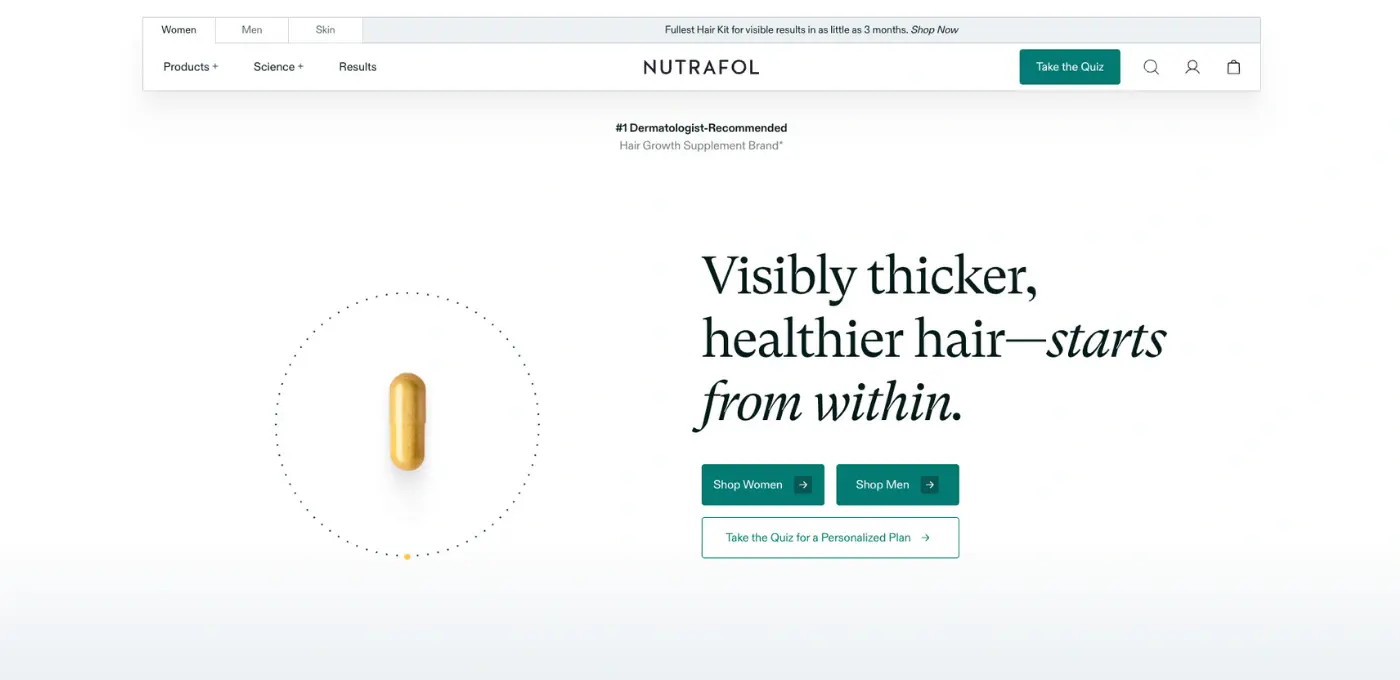
Nutrafol and Strut Health represent fundamentally different approaches to hair loss treatment: Nutrafol sells premium botanical supplements ($79/month on subscription, $88 one-time) through direct-to-consumer model without prescription requirements or medical supervision, targeting wellness-oriented consumers seeking natural alternatives, while Strut Health provides prescription hair loss treatment from $25/month, spanning FDA-approved finasteride 1mg tablets and compounded formulas containing finasteride, minoxidil, or dutasteride. Compounded medications are not FDA-approved and have not been reviewed by the FDA for safety, effectiveness, or quality. This comparison lays out the published evidence, regulatory status, and cost of each approach so you can weigh them with a licensed provider.
Platform Overview
Nutrafol is a premium supplement company specializing in botanical hair growth formulations sold through subscription e-commerce model without prescription requirements. The company positions as luxury wellness brand targeting health-conscious consumers willing to pay $79/month on subscription ($88 one-time) for a nutraceutical approach to hair loss through plant-based ingredients, adaptogens, and vitamins. Nutrafol does not employ physicians, does not require medical consultations, and operates as direct-to-consumer supplement retailer, according to
AAD treatment cost guidance.
Strut Health is prescription telehealth platform specializing in custom compound medications for hair loss, ED, and skincare with licensed physician consultations required for all treatments. The company compounds personalized prescription formulations containing finasteride, minoxidil, or dutasteride. Compounded medications are not FDA-approved and have not been reviewed by the FDA for safety, effectiveness, or quality. Its FDA-approved finasteride 1mg tablets start at $25/month with physician oversight included. For background on how these drugs work, see
NIH StatPearls - Androgenetic Alopecia and
AAD hair loss treatment information.
Treatment Approach: Supplements vs Prescription Medications
Nutrafol employs botanical supplement approach using saw palmetto, ashwagandha, curcumin, marine collagen, biotin, and proprietary plant extracts targeting hair growth through anti-inflammatory and stress-reduction mechanisms. The formulations do not contain FDA-approved hair loss medications (finasteride, minoxidil) and function as dietary supplements rather than pharmaceutical treatments. Clinical evidence for Nutrafol relies primarily on company-sponsored studies showing modest improvements in self-reported hair thickness and quality over 6 months.
Strut prescribes FDA-approved finasteride 1mg tablets alongside compounded formulas. In the PROPECIA (finasteride 1mg) trials described in the FDA label, an expert panel reviewing photographs found increased hair growth in 66% of treated men at 2 years, compared with 7% on placebo; at 5 years, 48% showed increased growth and 42% no further visible progression. Individual results vary. Dutasteride is not FDA-approved for hair loss, so prescribing it for hair is off-label, and Strut's compounded combinations have not been studied at that scale. Compounded medications are not FDA-approved and have not been reviewed by the FDA for safety, effectiveness, or quality.
Clinical Evidence and FDA Status
Nutrafol supplements are not FDA-approved for hair loss treatment and do not require FDA review as dietary supplements. Clinical evidence consists primarily of Nutrafol-sponsored studies showing 10-20% improvement in self-assessed hair quality without objective physician-graded endpoints. The American Academy of Dermatology does not recommend botanical supplements as first-line hair loss treatment, according to
FDA-approved hair loss treatments.
Strut prescribes finasteride 1mg, FDA-approved for male pattern hair loss in 1997, and topical minoxidil, FDA-approved for hair loss since 1988. In the PROPECIA trials described in the FDA label, 66% of treated men showed increased hair growth at 2 years versus 7% on placebo; individual results vary. Dutasteride is not FDA-approved for hair loss and is prescribed off-label. Strut's HairfectRx capsules and topicals are compounded. Compounded medications are not FDA-approved and have not been reviewed by the FDA for safety, effectiveness, or quality. American Academy of Dermatology guidelines list finasteride and minoxidil as first-line treatments for androgenetic alopecia.
Pricing and Value Analysis
Nutrafol charges $79/month on subscription ($88 for a one-time purchase) for its standard formulation; formulation-specific pricing can vary, so confirm current rates at checkout. Annual costs run about $948 at the subscription rate for botanical supplements without prescription medication benefits. The premium pricing reflects luxury brand positioning rather than superior clinical evidence - patients pay for wellness lifestyle branding and botanical ingredient marketing.
Strut Health charges $25/month for FDA-approved finasteride 1mg tablets with physician consultations and ongoing medical oversight; its compounded formulas cost more and are not FDA-approved. Annual costs run about $300 at the entry price. Despite the lower price, Strut includes medical consultations and prescription-strength medication.
Side Effects and Safety Profiles
Nutrafol botanical supplements generally well-tolerated in reported use, with occasional digestive upset or allergic reactions to plant ingredients. The product does not affect DHT hormone levels or cause sexual side effects associated with finasteride. However, lack of DHT suppression explains limited efficacy for androgenetic alopecia driven by DHT-mediated follicle miniaturization. Nutrafol offers safer profile but substantially reduced effectiveness.
Strut Health prescription medications (finasteride, dutasteride) carry potential side effects including sexual dysfunction (1.4-3.8% of users), reduced libido, and erectile difficulties. Most side effects resolve after discontinuation. Minoxidil side effects include scalp irritation and initial shedding phase. Strut physicians screen for contraindications and provide informed consent regarding risks. Whether that trade-off makes sense for you is a decision to make with a licensed provider.
Regulatory Status and Prescriber Requirements
Nutrafol operates as dietary supplement retailer without prescription requirements, physician consultations, or medical oversight. Customers purchase directly through website without medical screening for contraindications or drug interactions. The lack of medical supervision means no baseline lab testing, no monitoring for adverse effects, and no physician guidance on expected outcomes or combination therapies.
Strut Health requires physician consultation for all prescription treatments with medical screening for contraindications, baseline lab testing when appropriate (hormone panels, liver function), informed consent regarding side effects, and ongoing physician oversight throughout treatment. Medical supervision ensures appropriate patient selection, dosing optimization, and adverse effect management - critical safety advantages over unmonitored supplement self-treatment.
How We Compared Nutrafol vs Strut
Our Comparison Methodology
This comparison is based on comprehensive analysis of clinical evidence, FDA regulatory status, pricing structures, and treatment approaches from both platforms.
Clinical Evidence: Treatment recommendations reference FDA-approved medication information (FDA Finasteride Label).
Pricing Analysis: Pricing reflects the rates last recorded in our provider database; providers change prices frequently, so confirm current pricing directly at checkout.
Service Verification: Clinical evidence, FDA status, treatment protocols, and provider credentials were evaluated through detailed review of FDA databases and service offerings.
This comparison is written by our own editorial team, and ManyTreatments is paid an affiliate commission by most of the providers listed here when you buy through a link on this page. Payment for placement, for a rating, or for a listing is not something we accept. What we will not claim is that commissions have never influenced anything, because that would be a statement about our own conduct we cannot evidence. Our goal is to provide evidence-based comparison to help you make informed hair loss treatment decisions.
Final Verdict: Nutrafol vs Strut
Choose Nutrafol if: You prioritize absolute safety over maximal efficacy, prefer natural botanical approach despite limited clinical evidence, cannot tolerate prescription medication side effects, seek wellness lifestyle brand positioning, or want to supplement (not replace) prescription treatments.
Choose Strut Health if: You prioritize clinical efficacy supported by FDA approval and peer-reviewed evidence, seek cost-effective hair loss treatment (about $300/year vs about $948/year on recorded prices), require physician consultation and medical oversight, or follow evidence-based American Academy of Dermatology treatment guidelines recommending prescription medications as first-line therapy.
Bottom line: Prescription medications through Strut deliver superior hair loss prevention and regrowth at lower cost with medical supervision. Finasteride and minoxidil represent gold-standard treatments supported by 30+ years of clinical research. Nutrafol offers luxury supplement alternative with limited evidence, premium pricing, and modest efficacy. For medically appropriate candidates, Strut offers 5-year savings of roughly $3,240 at recorded rates compared to Nutrafol's botanical approach. Patients concerned about prescription side effects may consider Nutrafol, accepting reduced efficacy for improved safety profile.
Editorial Note: Researched and edited by our editorial team. AI tools assist with initial research and drafting; all content is fact-checked and edited by humans before publication. Learn more about our editorial standards