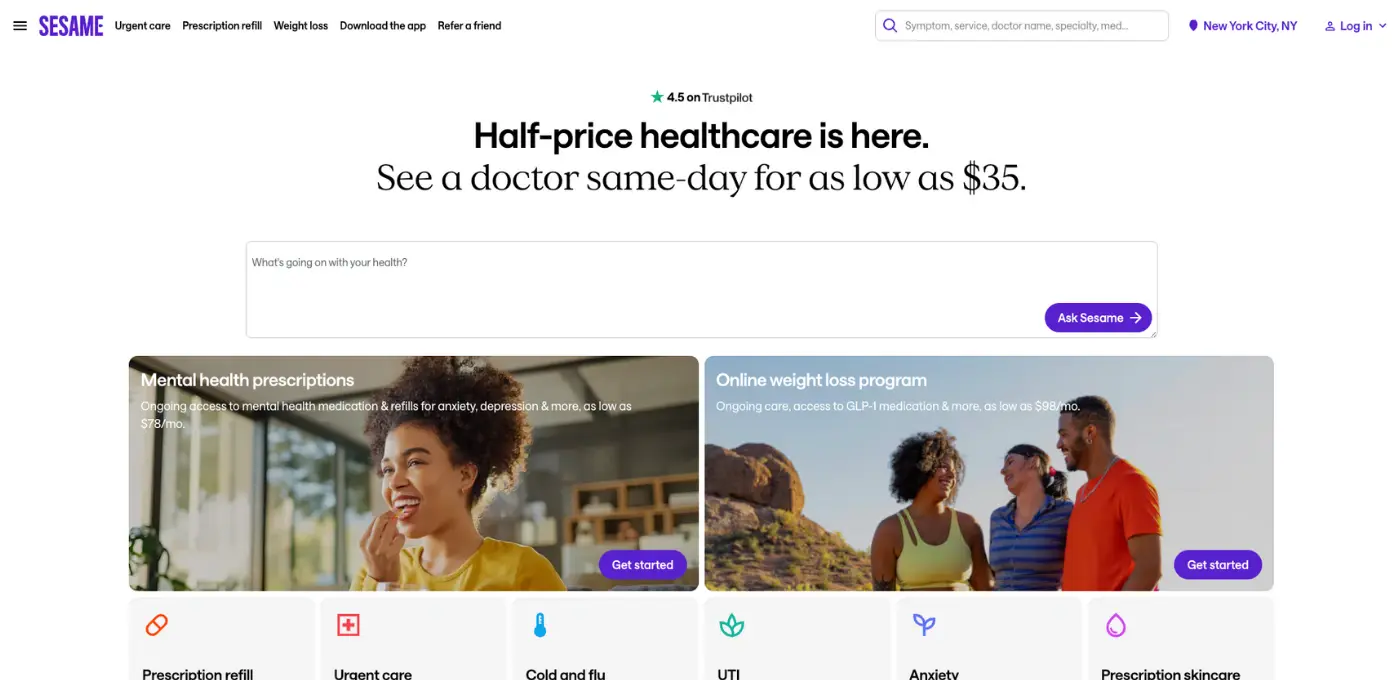
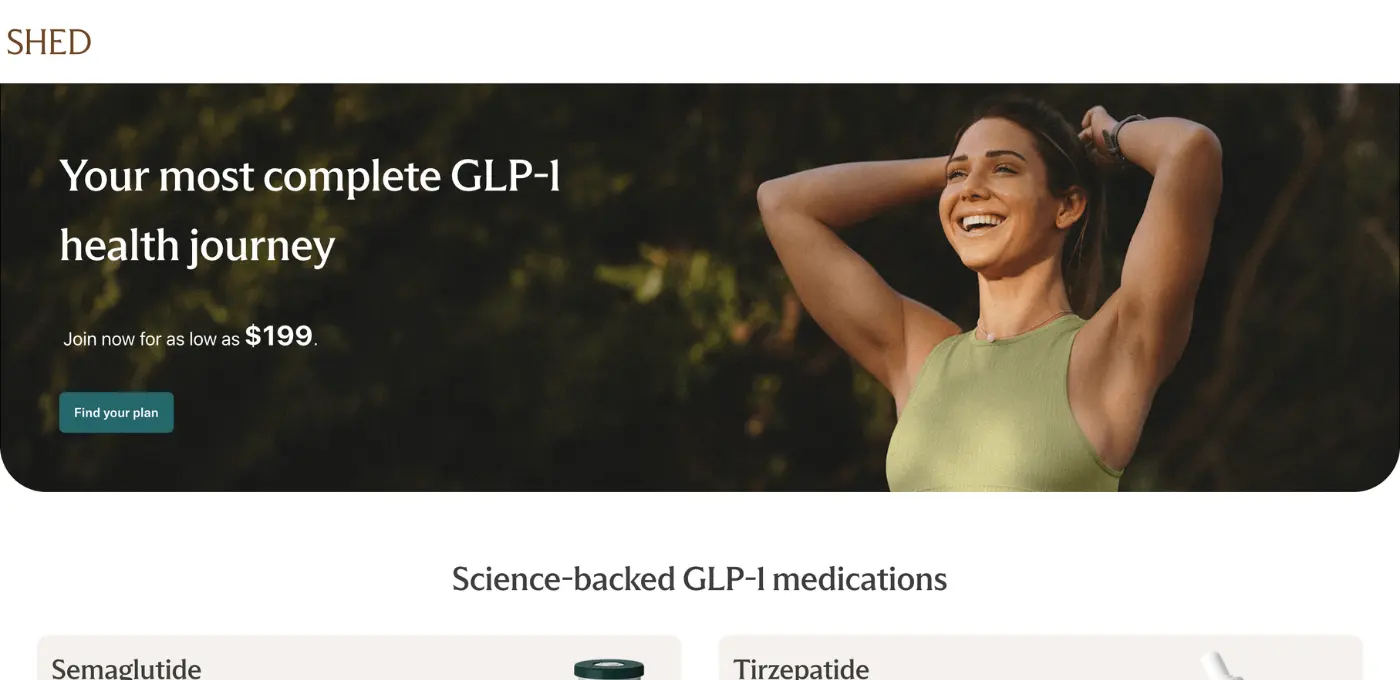
Sesame Care is a healthcare marketplace with provider choice and pay-per-visit pricing, while Shed is a subscription GLP-1 platform with a 120-day money-back guarantee if you do not lose 5% of your weight, subject to eligibility, required check-ins and adherence to the program. Very different models for weight loss treatment.
Platform Overview
Sesame Care is a healthcare marketplace platform that connects patients directly with independent licensed providers for a transparent, fee-for-service model, with weight loss visits from $59 per month plus medication from $149 per month. Unlike traditional telehealth platforms with employed clinical teams, Sesame operates as a marketplace where independent physicians and nurse practitioners list their services at transparent prices. This model allows patients to compare provider options and select based on price, specialty, and reviews. For GLP-1 weight loss, patients find providers on Sesame who can evaluate and prescribe appropriate medications. The transparent pricing model appeals to cost-conscious patients who want to see exactly what they are paying for. FDA prescribing standards apply to all providers on the Sesame marketplace.
Shed is a vertically integrated GLP-1 weight loss specialist offering programs from $159 per month on a 12-month term (tirzepatide from $239) with a unified clinical team, dedicated coaching, and a 120-day refund term if you do not lose 5% of your weight, with eligibility, check-in and adherence conditions. Where Sesame is a marketplace that connects patients with independent providers, Shed is a purpose-built program with a consistent clinical model and coaching infrastructure. The
CDC's evidence on weight loss program effectiveness supports Shed's integrated program approach over marketplace-style care for patients who need ongoing behavioral support and accountability.
Pricing Comparison
Sesame Care's weight loss pricing (visits from $59 per month plus medication from $149 per month) reflects the marketplace model, where independent providers set their own rates competitively. The transparent pricing is genuinely useful for cost comparison, and patients can sometimes find lower-priced options on Sesame than through integrated platforms. However, because Sesame is a marketplace, the total cost of care - including separate pharmacy costs, follow-up visit fees, and the lack of bundled coaching - may exceed headline pricing for patients who require ongoing support.
NIH research shows that fragmented care often costs more per outcome than integrated programs.
Shed's pricing, from $159 per month on a 12-month term with tirzepatide from $239, is all-inclusive within each tier, bundling clinical oversight, coaching, and program management into a single monthly cost. Shed also advertises a conditional 120-day money-back guarantee (lose 5% of your weight or get a refund, subject to eligibility and program adherence), which a marketplace of independent providers does not offer. For patients comparing total cost of care rather than headline pricing, Shed's bundled model and guarantee may deliver better value than the seemingly lower cost of Sesame's marketplace approach.
Medication Options and Quality
Sesame Care providers can prescribe semaglutide and tirzepatide, with the prescribing provider managing medication selection and dosing based on patient evaluation. Because Sesame is a marketplace of independent providers, the medication management approach varies by provider, and patients should verify their selected provider's experience with GLP-1 titration before committing. The marketplace model means there is less standardization in dosing protocols and follow-up schedules than integrated platforms. Tirzepatide's documented 20%+ average weight loss in
NEJM trials is accessible through qualified Sesame providers who specialize in metabolic medicine.
Shed prescribes semaglutide and tirzepatide with standardized, evidence-based clinical protocols and medication management integrated into the coaching program. Dose adjustments are coordinated with the patient's progress and behavioral support rather than handled as standalone clinical decisions. The consistency of Shed's medication management approach across all patients reflects a unified clinical model that marketplace platforms inherently cannot provide.
NEJM semaglutide efficacy data shows strong outcomes when appropriate dosing and monitoring are consistently applied.
Medical Team and Support
Sesame Care's marketplace model means the quality and depth of medical support depends significantly on which provider a patient selects. Highly rated GLP-1 specialists on Sesame can provide excellent clinical care, but the platform's support infrastructure is limited to the individual provider's practice model rather than a coordinated care team. There is no dedicated coaching layer built into Sesame's structure, as each provider operates independently. Patients who select well and work with experienced GLP-1 providers on Sesame can receive strong clinical care, but behavioral coaching support requires either a provider who incorporates it or supplemental resources. Published behavioral research suggests that structured coaching beyond clinical visits improves outcomes.
Shed's medical support is structured as a unified program with licensed clinical oversight and weight loss coaches working in coordination. Every Shed patient receives the same core support infrastructure regardless of which provider they are assigned to, ensuring consistent access to coaching, proactive check-ins, and goal-oriented program management. The
American Association of Clinical Endocrinology recommends this integrated model.
Weight Loss Approach and Programs
Sesame Care's approach to weight loss is as varied as its provider marketplace - each provider brings their own clinical philosophy, follow-up structure, and support style. Patients who research providers carefully and select one with a strong GLP-1 track record and behavioral coaching orientation can construct a quality weight loss program through Sesame. However, the inherent variability of the marketplace model means the weight loss program quality is determined by provider selection rather than platform design. For patients who are experienced healthcare consumers who can evaluate providers effectively, Sesame's model is workable.
Shed pairs GLP-1 medication with coaching and advertises a 120-day money-back guarantee if you do not lose 5% of your weight, subject to eligibility, required check-ins and adherence to the program. The program is consistent across all patients, ensuring no one falls through the cracks due to provider variability or marketplace inconsistency. This standardized-yet-model - with coaching customized to each patient's needs but within a consistent program framework - represents the evidence-based optimal approach for GLP-1 weight loss treatment at scale.
User Experience and Satisfaction
Sesame Care users appreciate the price transparency and the ability to compare and select providers based on reviews, specialty, and cost. The marketplace model empowers patients who want agency in their provider selection and find value in seeing exactly what they are paying for before committing. Some users note that the experience quality varies significantly based on provider selection, and that the lack of integrated coaching or program continuity means weight loss progress is largely self-managed beyond the clinical visits. Patients who select highly rated GLP-1 specialists on Sesame tend to report better experiences than those who select based primarily on lowest price.
Reviewers describe a unified program experience driven by the coaching model. The platform's purpose-built design for weight loss management - with coordinated coaching, clinical oversight, and outcome tracking - creates a more cohesive experience than marketplace-based care. For patients who have experienced inconsistent care from marketplace providers, Shed's integrated program model addresses that fragmentation directly.
NIH research confirms program consistency improves GLP-1 adherence.
How We Compared Sesame Care vs Shed
Our Comparison Methodology
This comparison is based on analysis of pricing structures and service models from both platforms.
Clinical Evidence: Weight loss treatment recommendations reference FDA-approved GLP-1 medication information (FDA Wegovy Label) and clinical efficacy data from The New England Journal of Medicine.
Pricing Analysis: Pricing reflects the rates last recorded in our provider database; providers change prices frequently, so confirm current pricing directly at checkout.
Service Verification: Platform capabilities, provider credentials, and service quality were evaluated through detailed review of service offerings.
Our analysis is our own editorial work. Most of the providers compared here pay ManyTreatments a commission when you buy through a link on this page. Nobody pays us for a placement, a rating, or a listing, and we are not going to add that commissions have never influenced anything, because that is a claim about our own conduct we cannot show you evidence for. Our goal is to provide evidence-based comparison to help you make informed weight loss treatment decisions.
Final Verdict: Sesame Care vs Shed
Choose Sesame Care if: You are a self-directed healthcare consumer who values price transparency and the ability to select and compare licensed providers independently. Sesame's marketplace model is best for patients who are experienced at evaluating provider quality and want agency in their care choices.
Choose Shed if: You want a structured, integrated weight loss program with consistent clinical oversight, dedicated coaching, and a 120-day money-back guarantee if you do not lose 5% of your weight, subject to eligibility, required check-ins and adherence to the program. Shed's vertically integrated model is the better fit if you want a managed weight loss program with a conditional money-back guarantee.
Bottom line: Sesame Care and Shed represent fundamentally different approaches - marketplace versus integrated program. For outcome-focused patients who want consistent, accountable care, Shed's unified program model is the stronger choice. Sesame's transparency is a genuine advantage if you are experienced at evaluating providers, but the absence of program consistency and a refund term makes it less well-suited if you need a structured, supported program.
Editorial Note: Researched and edited by our editorial team. AI tools assist with initial research and drafting; all content is fact-checked and edited by humans before publication. Learn more about our editorial standards