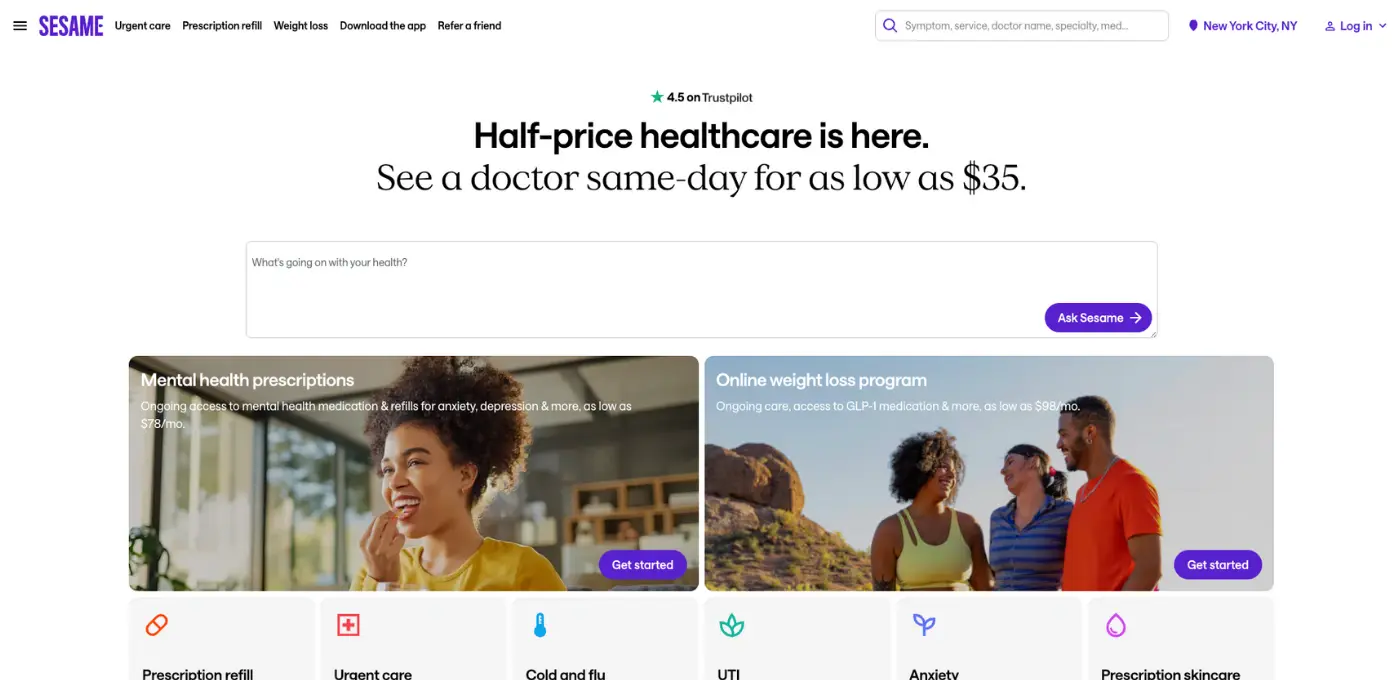
Sesame Care and Sprout represent different healthcare delivery approaches - established marketplace with provider choice and multi-service integration versus value-tier standardized single-category platform. Sesame connects you with independent providers across weight loss, primary care, mental health, and specialty services at marketplace-determined pricing ($149-299/month typical) with 5+ years of track record, while Sprout provides consistent standardized GLP-1 access starting at $149/month for compounded semaglutide and $199/month for compounded tirzepatide, verified September 17, 2026. Sprout's rates fall inside Sesame's typical range rather than below it, so this comparison is about what marketplace provider choice, multi-service integration and customization are worth to you, not about which one is cheaper.
Platform Overview
Sesame Care launched in 2019 as a healthcare marketplace platform connecting patients directly with providers for cash-pay services across multiple specialties including primary care, mental health, urgent care, women's health, weight loss, and specialty consultations. With 5+ years of history and focus on transparent cash pricing eliminating insurance middlemen, Sesame positions as affordable healthcare marketplace serving patients seeking direct provider relationships.
The platform operates as marketplace rather than direct provider, connecting patients with independent physicians, nurse practitioners, and specialists who set their own pricing. For weight loss treatment, Sesame offers GLP-1 services through marketplace providers at varying prices, typically $149-299/month depending on provider and medication. The marketplace model enables provider choice and transparent pricing, according to
FDA semaglutide safety information.
Sprout is a weight loss telehealth platform built around compounded GLP-1 access without premium service layers. We can't verify its founding date, operating history or funding from our data, so we won't rank it on track record. What our listing shows is compounded semaglutide from $149/mo and compounded tirzepatide from $199/mo, verified September 17, 2026, with basic clinical support.
The platform offers asynchronous consultations with nurse practitioners or physicians, compounded GLP-1 medications (semaglutide and tirzepatide options), and basic ongoing support focused on medication management. Sprout publishes a starting price per medication, $149/mo for compounded semaglutide and $199/mo for compounded tirzepatide, verified September 17, 2026, and does not publish what a higher dose costs.
Service Model and Provider Access
Sesame Care Marketplace Provider Choice: Sesame connects patients with independent licensed providers who maintain their own practices and set their own service standards, pricing, and clinical protocols. Patients can view provider profiles, credentials, ratings, and pricing before selecting providers for consultations. This marketplace model offers provider choice and transparency but creates service variability across different providers.
For weight loss treatment, provider quality and protocols vary based on individual provider expertise and practice standards. Some providers offer in-depth consultations with lifestyle guidance, while others provide basic GLP-1 prescribing. Patients must research providers and select based on credentials, reviews, and approach. The marketplace enables finding providers matching specific preferences but requires patient initiative in provider evaluation, according to
FDA semaglutide safety information.
Sprout Standardized Value-Tier Service: Sprout employs staff providers delivering standardized consultations focused on GLP-1 eligibility screening and medication management. The platform uses questionnaire-based assessment with asynchronous provider review, enabling efficient processing while maintaining consistent service quality. All patients receive same service model focused on reliable value-tier care.
This standardized approach eliminates provider choice but ensures consistent quality across all patients at predictable value-tier pricing. For patients wanting reliable straightforward service without researching multiple providers, Sprout's standardized model offers simplicity. For those valuing provider choice and ability to customize care, Sesame's marketplace provides flexibility through provider diversity.
Service Scope and Healthcare Integration
Sesame Care Multi-Category Marketplace: Sesame operates as healthcare marketplace offering services across numerous categories through independent providers: primary care, mental health, urgent care, women's health, weight loss, dermatology, specialty consultations, lab testing, imaging services, and preventive care. This marketplace approach enables wide-ranging healthcare access through single platform.
For patients managing weight loss alongside other health needs, Sesame enables coordinating multiple services through unified marketplace. Patients can access primary care physicians, mental health therapists, lab testing services, and specialty consultations with transparent pricing. The marketplace facilitates comprehensive healthcare coordination through provider diversity.
Sprout Single-Category Focus: Sprout offers exclusively weight loss treatment with compounded GLP-1 medications, providing no additional health categories or services beyond basic GLP-1 access. The platform focuses on straightforward medication management without multi-category coordination or marketplace breadth.
This narrow focus enables value-tier pricing while maintaining quality standards for weight loss specifically. Patients needing primary care, mental health services, lab testing, or other health services must coordinate through separate platforms. The single-category limitation creates care fragmentation for full-spectrum health needs but enables focused value pricing for isolated weight loss treatment.
Pricing and Cost Structure
Sesame Care Marketplace Transparent Pricing: Sesame displays transparent cash pricing set by independent providers, typically $149-299/month for weight loss services depending on provider, consultation frequency, and medication type. The marketplace enables price comparison across providers and transparent cost understanding before commitment. Provider competition within marketplace can drive reasonable pricing.
Annual costs for weight loss through Sesame range $1,788-3,588 depending on provider selection and medication tier. The marketplace model enables cost-conscious provider selection while maintaining service quality through provider competition and patient reviews.
Sprout Starting Prices: Sprout lists compounded semaglutide from $149/mo and compounded tirzepatide from $199/mo, verified September 17, 2026, both of which land inside the $149-299/month band typical of Sesame's marketplace providers. Each figure is a starting price at the opening dose, and Sprout does not publish what you pay once the dose steps up.
Against Sesame's typical $149-299/month, Sprout's starting rates sit at the bottom and the middle of that same band, so Sprout can land above or below depending on the provider you pick there and the dose you end up on. Treat this as a like-for-like check rather than a saving. What you give up at Sprout is marketplace provider choice, multi-category healthcare access and customized service; what you get back is a published entry price on each molecule.
What $59/mo Plus Medication Actually Gets You, Against Sprout's Starting Rates
As of September 2026, Sesame Care starts weight loss at $59/mo plus the cost of your medication (9.1 Excellent); Sprout starts compounded semaglutide at $149/mo and compounded tirzepatide at $199/mo (9.0 Excellent).
Sprout's plan covers compounded semaglutide and tirzepatide only, delivered in refrigerated packaging; compounded medications are not FDA-approved and have not been reviewed by the FDA for safety, effectiveness, or quality.
Sesame Care's listing doesn't specify FDA-approved-versus-compounded status the way Sprout's does, so if that distinction matters to you, confirm the medication type directly with Sesame Care's provider before you enroll.
Customization vs Standardization
Sesame Care Customizable Provider Selection: Sesame's marketplace model enables patients to customize healthcare relationships by selecting providers matching individual preferences, expertise needs, communication styles, and approaches. Patients dissatisfied with one provider can select different providers for future services, enabling ongoing optimization of provider relationships.
This customization proves valuable for patients with specific preferences (wanting full lifestyle counseling, preferring certain communication styles, needing provider expertise in specific areas). The marketplace enables building healthcare team across multiple specialties while maintaining unified platform access. For patients valuing control over provider selection, Sesame delivers maximum customization.
Sprout Streamlined Standardized Service: Sprout's standardized service model eliminates provider selection complexity, delivering consistent value-tier care without requiring patient research of multiple providers. All patients receive same reliable service focused on efficient GLP-1 medication management at predictable quality and pricing.
This standardization proves valuable for patients wanting straightforward service without complexity of provider evaluation. The consistent approach ensures reliable quality without surprises, though eliminates customization benefits. For patients prioritizing simplicity and predictable value over provider choice, Sprout's standardized model offers streamlined efficiency.
How We Compared Sesame Care vs Sprout Health
This comparison analyzes Sesame Care and Sprout based on service models, provider access, healthcare integration, and pricing structures.
Pricing Analysis:
- Sesame Care: $149-299/month ($1,788-3,588/year) marketplace pricing with provider choice
- Sprout: compounded semaglutide from $149/mo and compounded tirzepatide from $199/mo, verified September 17, 2026, standardized service, with no published rate for higher doses
- Cost difference: Sprout's starting rates fall inside Sesame's typical $149-299/month band, so which is cheaper depends on the provider compared and the dose you reach
Service Differentiation:
- Sesame Care: Healthcare marketplace with provider choice and multi-service access
- Sprout: Value-tier standardized single-category platform
- Customization and breadth vs focused value efficiency positioning
Quality Considerations:
- Maturity: 5+ years for the Sesame marketplace; not verifiable from our data for Sprout
- Service model: Variable quality through provider choice vs consistent standardized quality
- Healthcare integration: Comprehensive marketplace vs single-category focus
Final Verdict: Sesame Care vs Sprout Health
Choose Sesame Care if: You need multiple health services beyond just weight loss (primary care, mental health, labs, specialty care), want provider choice and ability to select based on expertise and preferences, value marketplace transparency with upfront pricing comparison, require comprehensive healthcare coordination through unified platform, seek proven platform staying power (5+ years), want ability to build long-term relationships with selected independent providers, need flexibility to change providers if unsatisfied, or prioritize marketplace breadth and provider diversity over cost minimization.
Choose Sprout if: You need only weight loss treatment without additional health services, want straightforward standardized service without provider selection complexity, value a published entry price on each molecule ($149/mo compounded semaglutide, $199/mo compounded tirzepatide, verified September 17, 2026), prefer a simplified service model over marketplace customization, can accept single-category focus without multi-service coordination, would rather have one bill than marketplace breadth, want reliable baseline quality without researching providers, and are willing to ask what a higher dose costs before you commit.
Bottom line: Sesame Care and Sprout represent different value propositions - established healthcare marketplace with provider choice and multi-service integration versus value-tier standardized single-category platform. Sesame's typical $149-299/month brackets both of Sprout's starting rates, and what the upper end of that band buys is provider diversity, multi-category healthcare access, customization through provider selection, and a proven 5+ year record. Sprout offers a published entry price on each molecule and one consistent service, but eliminates marketplace benefits and multi-service coordination and says nothing about higher-dose pricing. If you need full healthcare coordination, provider customization, or multiple health services, Sesame delivers superior value through its marketplace. If you want a straightforward standardized weight loss service at value pricing without marketplace complexity, Sprout is the efficient, reliable alternative. The marketplace versus standardized choice depends on whether provider customization and healthcare breadth are worth more to you than a single published starting rate.
Editorial Note: Researched and edited by our editorial team. AI tools assist with initial research and drafting; all content is fact-checked and edited by humans before publication. Learn more about our editorial standards