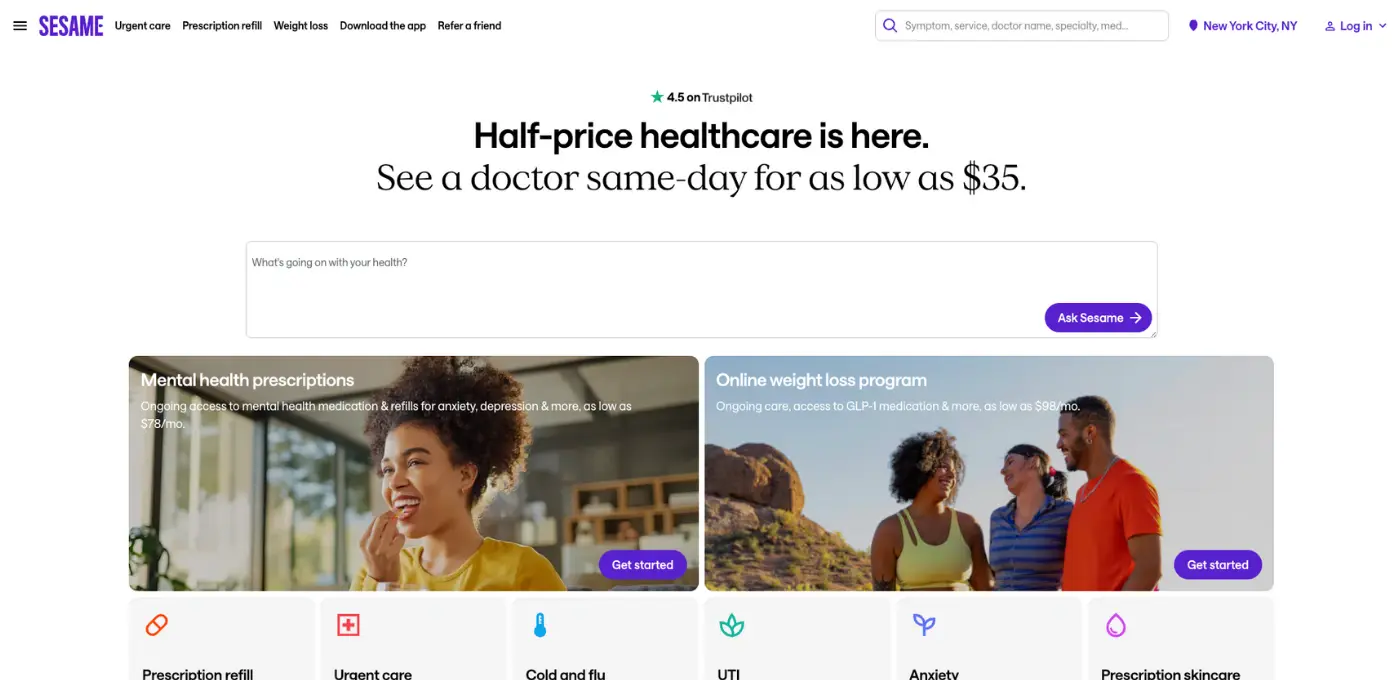
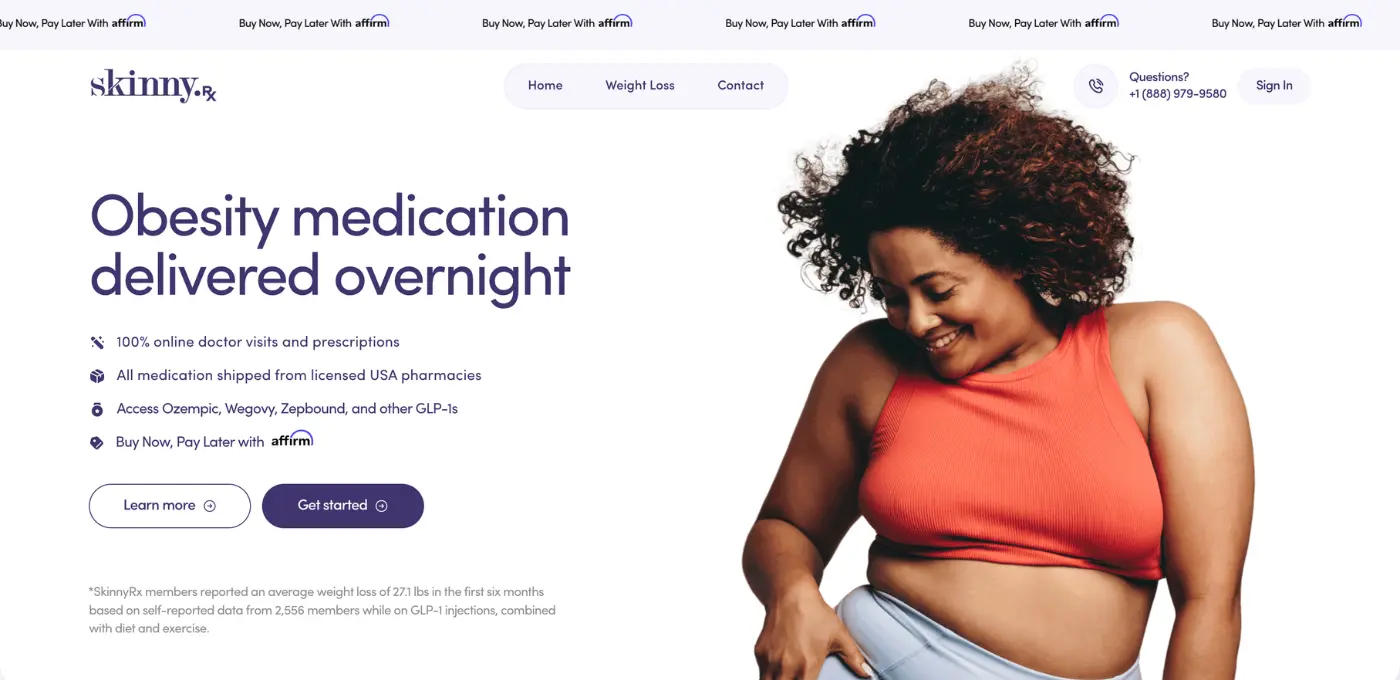
Sesame Care and Skinny.rx represent fundamentally different healthcare models - established marketplace with provider choice and multi-service integration versus ultra-budget single-category startup with minimal standardized service. Sesame connects patients with independent providers across weight loss, primary care, mental health, and specialty services at marketplace-determined pricing ($149-299/month typical) with 5+ year of track record, while Skinny.rx provides bare-minimum compounded semaglutide at $49-99/month with <2 years of history. This comparison analyzes whether Skinny.rx's $1,200-2,400/year cost savings justify complete loss of provider choice and multi-service healthcare integration, helping patients choose between full healthcare marketplace and rock-bottom single-service access.
Platform Overview
Sesame Care launched in 2019 as a healthcare marketplace platform connecting patients directly with providers for cash-pay services across multiple specialties including primary care, mental health, urgent care, women's health, weight loss, and specialty consultations. With 5+ years of history and focus on transparent cash pricing eliminating insurance middlemen, Sesame positions as affordable healthcare marketplace serving patients seeking direct provider relationships.
The platform operates as marketplace rather than direct provider, connecting patients with independent physicians, nurse practitioners, and specialists who set their own pricing. For weight loss treatment, Sesame offers GLP-1 services through marketplace providers at varying prices, typically $149-299/month depending on provider and medication. The marketplace model enables provider choice and transparent pricing but creates variability in service quality and clinical protocols, according to
FDA semaglutide safety information.
Skinny.rx launched in 2023 as an ultra-budget weight loss telehealth startup focused exclusively on GLP-1 medication access at the lowest possible price point. With less than 2 years of history, minimal public funding information, and singular focus on cost-optimized weight loss treatment, Skinny.rx positions itself as the most affordable GLP-1 option in the telehealth market at $49-99/month for compounded semaglutide.
The platform offers basic asynchronous consultations with nurse practitioners or physicians, direct-to-consumer shipping of compounded GLP-1 medications, and minimal ongoing support beyond medication refills. Skinny.rx serves patients across multiple states with focus on transactional efficiency rather than full-service care coordination.
Service Scope and Healthcare Model
Sesame Care Marketplace Multi-Category Access: Sesame operates as healthcare marketplace offering services across numerous categories through independent providers: primary care, mental health, urgent care, women's health, weight loss, dermatology, specialty consultations, lab testing, imaging services, and preventive care. This marketplace approach enables full healthcare access through single platform connecting patients with diverse providers.
For weight loss specifically, Sesame connects patients with providers offering GLP-1 treatment alongside ability to access primary care, mental health services, lab testing, and other health needs through same marketplace. According to healthcare marketplace research, marketplace models increase healthcare access through transparent pricing and provider choice. Patients can coordinate multiple health needs through unified marketplace while maintaining direct provider relationships.
Skinny.rx Single-Category Ultra-Budget Focus: Skinny.rx offers exclusively weight loss treatment with compounded semaglutide, providing no additional health categories, marketplace services, healthcare access. The platform provides basic medical consultations focused solely on GLP-1 eligibility screening, prescription authorization, and medication refills without multi-category coordination.
This narrow focus enables aggressive cost optimization but eliminates healthcare marketplace benefits completely. Patients needing primary care, mental health services, lab testing, or other health services must coordinate these needs through entirely separate platforms. The single-category limitation creates care fragmentation for any health needs beyond basic weight loss medication access.
Provider Model and Service Variability
Sesame Care Marketplace Provider Diversity: Sesame connects patients with independent licensed providers who maintain their own practices and set their own service standards, pricing, and clinical protocols. Patients can view provider profiles, credentials, ratings, and pricing before selecting providers for consultations. This marketplace model offers provider choice and transparency but creates service variability across different providers.
For weight loss treatment, provider quality and protocols vary based on individual provider expertise and practice standards. Some providers offer consultations with lifestyle guidance, while others provide basic GLP-1 prescribing. Patients must research providers and select based on credentials, reviews, and approach. The marketplace model enables finding providers matching specific preferences but requires patient initiative in provider selection and evaluation, according to
FDA semaglutide safety information.
Skinny.rx Standardized Minimal Service: Skinny.rx employs staff providers delivering standardized basic consultations focused on GLP-1 eligibility and prescription authorization. The platform uses questionnaire-based assessment without video visits, limiting full health assessment. All patients receive same minimal service model focused on transactional efficiency.
This standardized approach eliminates provider choice but ensures consistent (though minimal) service across all patients. The lack of provider diversity means no ability to select providers based on expertise, approach, or credentials. For patients wanting provider choice and ability to find full-service care providers, Sesame's marketplace offers advantages. For those accepting minimal standardized service, the lack of choice may not matter.
Pricing and Cost Structure
Sesame Care Marketplace Transparent Pricing: Sesame displays transparent cash pricing set by independent providers, typically $149-299/month for weight loss services depending on provider, consultation frequency, and medication type. Consultation fees typically range $25-99 per visit, with medication costs separate. The marketplace enables price comparison across providers and transparent cost understanding before commitment.
This transparent pricing model helps patients find services matching budgets while understanding exact costs upfront. Provider competition within marketplace can drive reasonable pricing, though not necessarily lowest market prices. Annual costs for weight loss through Sesame range $1,788-3,588 depending on provider selection and medication tier. The marketplace model enables cost-conscious provider selection while maintaining service quality through provider competition.
Skinny.rx Ultra-Budget Pricing: Skinny.rx charges $49-99/month for compounded semaglutide access - among the absolute lowest GLP-1 pricing in the telehealth market. This all-inclusive rock-bottom pricing covers consultations and medications but reflects minimal overhead. Annual costs range $588-1,188 for compounded semaglutide.
This represents $1,200-2,400/year savings compared to Sesame's typical pricing. However, these cost savings come with extreme tradeoffs: no marketplace provider choice, no multi-category healthcare access, minimal clinical support, a <2 year history, and substantial business failure risk. For patients needing only bare-minimum GLP-1 access, the cost difference is substantial. For those valuing marketplace provider choice and multi-category healthcare access, Sesame's pricing earns its premium.
Two Ways to Pay for the Same Category
As of August 2026, Sesame Care starts weight loss at $59/mo plus medication cost (9.1 Excellent); Skinny.Rx is a flat $199/mo (9.0 Excellent).
Skinny.Rx's menu runs from compounded semaglutide at $149.25/mo up to compounded tirzepatide at $224.25/mo, with an FDA-approved Wegovy option as well; compounded versions aren't FDA-approved and haven't been reviewed by the FDA for safety, effectiveness, or quality.
Sesame Care is also active across five categories with us against Skinny.Rx's one (weight loss only), so if you need care beyond GLP-1s, that's the practical difference, not platform trustworthiness.
Healthcare Integration and Multi-Service Coordination
Sesame Care Full Healthcare Marketplace: Sesame enables patients to coordinate multiple health needs through unified marketplace - weight loss providers, primary care physicians, mental health therapists, lab testing services, specialty consultations, and preventive care all accessible through single platform. This integrated marketplace approach allows building healthcare relationships while maintaining transparent cash pricing.
For patients managing weight loss alongside diabetes care, mental health treatment, or other conditions, Sesame enables coordinating multiple providers within unified platform. Patients can access lab testing for metabolic monitoring, mental health support for eating behavior issues, and primary care for comorbidity management - all with transparent pricing and direct provider relationships. The marketplace model facilitates healthcare coordination impossible with single-category platforms.
Skinny.rx Zero Healthcare Integration: Skinny.rx offers no healthcare integration, marketplace services, or multi-category coordination whatsoever. The platform provides only basic weight loss medication access with no ability to coordinate lab testing, primary care, mental health services, or other health needs through platform.
Patients must independently coordinate all additional healthcare needs through completely separate providers and platforms. Those needing lab monitoring, diabetes management, mental health support, or primary care oversight must build separate healthcare relationships without integrated coordination. The complete lack of healthcare integration creates maximum care fragmentation for patients with any health complexity beyond isolated weight loss.
How We Compared Sesame Care vs Skinny.Rx
This comparison analyzes Sesame Care and Skinny.rx based on service models, healthcare integration, provider choice, and pricing structures. Analysis incorporates considerations for care coordination and risk assessment for long-term treatment commitments.
Clinical Evidence:
Pricing Analysis:
- Sesame Care: $149-299/month ($1,788-3,588/year) marketplace pricing with provider choice and multi-service access
- Skinny.rx: $49-99/month ($588-1,188/year) ultra-budget single-category without marketplace benefits
- Cost difference: $1,200-2,400/year savings with Skinny.rx but loss of marketplace infrastructure and healthcare integration
Service Differentiation:
- Sesame Care: Healthcare marketplace with provider choice and multi-category coordination
- Skinny.rx: Ultra-budget single-category platform with minimal standardized service
- Marketplace infrastructure vs extreme cost minimization positioning
Quality Considerations:
- Maturity: 5+ years marketplace platform (Sesame) vs <2 years startup (Skinny.rx)
- Service model: Provider choice and customization vs standardized minimal service
- Healthcare integration: Marketplace vs zero integration
Final Verdict: Sesame Care vs Skinny.Rx
Choose Sesame Care if: You need multiple health services beyond just weight loss (primary care, mental health, labs, specialty care), want provider choice and ability to select based on expertise and approach, value marketplace transparency with upfront pricing, require healthcare coordination through unified platform, seek a platform that has already proven it can last (5+ years), want ability to build long-term relationships with independent providers, need flexibility to coordinate various health needs, or prioritize healthcare integration over cost minimization.
Choose Skinny.rx if: You need only bare-minimum isolated GLP-1 access without any additional health services, want the absolute lowest possible GLP-1 pricing ($49-99/month), have no need for provider choice or healthcare marketplace benefits, can manage completely independently with minimal clinical support, accept extreme uncertainty and substantial business failure risk (<2 years), have straightforward health without any conditions requiring coordinated care, don't need multi-service healthcare access or provider selection, and prioritize maximum cost savings ($1,200-2,400/year) over provider choice, healthcare integration, and certainty.
Bottom line: Sesame Care and Skinny.rx represent fundamentally different models - established healthcare marketplace with provider choice and multi-service integration versus ultra-budget single-category startup with minimal standardized service. Sesame charges $100-200/month premium for provider diversity, multi-category healthcare access, transparent pricing with provider choice, and a proven 5+ year run. Skinny.rx offers substantial cost savings but eliminates all marketplace benefits, healthcare integration, provider choice, and carries extreme risk. For patients needing healthcare coordination, provider selection flexibility, or multiple health services, Sesame delivers vastly superior value through its provider marketplace. For severely financially-constrained patients with straightforward isolated weight loss needs accepting substantial risk, Skinny.rx enables basic GLP-1 access at lowest cost. The marketplace versus ultra-budget choice depends on whether all of that justifies $1,200-2,400/year premium over bare-minimum medication access.
Editorial Note: Researched and edited by our editorial team. AI tools assist with initial research and drafting; all content is fact-checked and edited by humans before publication. Learn more about our editorial standards